
AC Running But Not Cooling
Your air conditioner may still be running even though the cooling process has stopped. This guide explains what that usually means, what you can safely check, and when professional service makes sense.
Serving Harford County, Baltimore County, and Howard County.
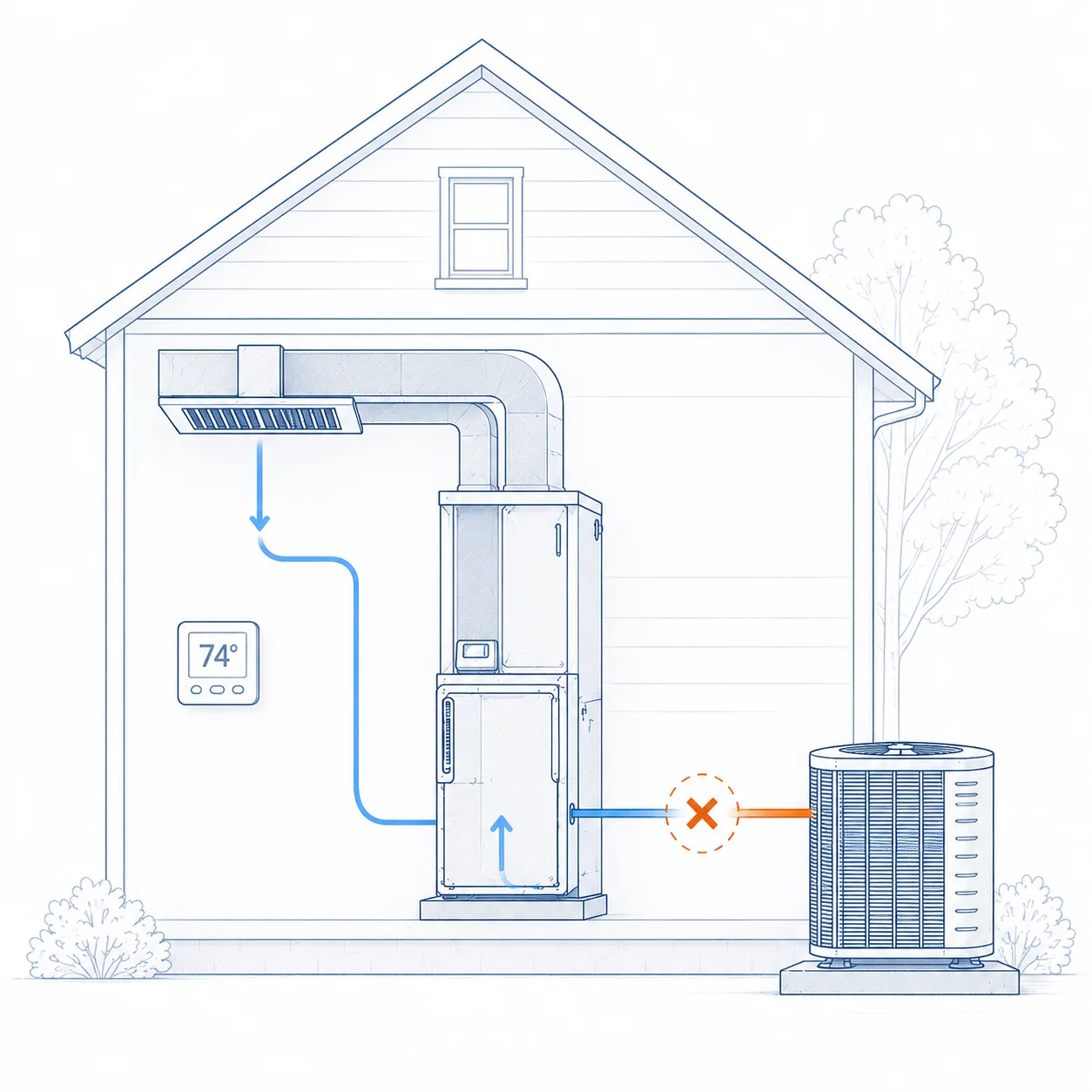
At a Glance
An air conditioner can appear to be running even when the cooling process is not working correctly. Air may still move from the vents, the thermostat may say cooling, or the outside unit may be running, but the home keeps getting warmer.
Running parts do not guarantee cooling performance.
Airflow, electrical, outdoor-unit, frozen-coil, control, and refrigerant issues can overlap.
Diagnosis protects you from replacing parts by guesswork.
The Cooling Process
A working air conditioner follows a simple chain. When your system is running but the house is not cooling, one part of that chain may have stopped doing its job even though other parts still appear active.
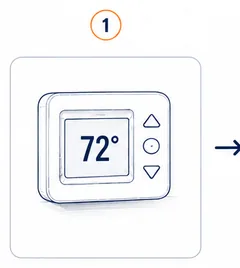
The thermostat asks the system to start removing heat from the home.
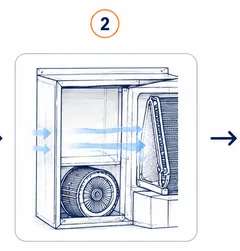
Air moves across the indoor coil so heat can be removed from the living space.
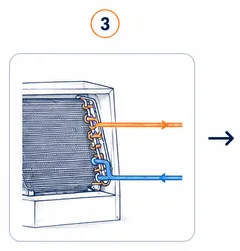
The refrigerant circuit moves absorbed heat from the indoor coil toward the outdoor unit.
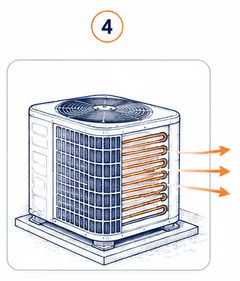
The outdoor condenser rejects heat outside so cooling can continue indoors.
This is why proper diagnosis matters. The goal is to find where the cooling process stopped, then determine why.
Quick Answer
If your AC is running but not cooling, the most common categories to consider are airflow problems, thermostat or control issues, electrical problems, outdoor unit problems, a frozen evaporator coil, dirty coils, or refrigerant-related conditions.
Homeowners often describe this as AC blowing warm air, warm air coming from vents, the house getting warmer even though the thermostat says cooling, the outside unit running without comfort improving, or the AC running all day without reaching temperature.
Homeowners can safely check thermostat settings, air filter condition, open vents, return-air blockage, outdoor-unit clearance, visible ice, and whether a breaker appears tripped. Do not open equipment, add refrigerant, repeatedly reset breakers, replace random parts, or keep running cooling mode if ice is visible.
If the outside unit appears to be running but the vents are still warm, remember that the outdoor fan and compressor perform different jobs. Fan operation is useful information, but it is not a diagnosis. A future field guide will explain this specific situation in more detail.
First 30 Seconds
- Check the thermostat setting.
- Look at the air filter.
- See if ice is visible.
- Make sure vents are open.
- Look for blocked outdoor-unit airflow.
- Read the rest of this guide before assuming the cause.
What can I safely check myself?
These checks are observations, not repairs. They can help you understand what is happening and give a technician better information before the visit.
Confirm it is set to cooling and the temperature setting is below the room temperature.
Look for a heavily dirty, blocked, or collapsed filter. Replace it only if you already know the correct size and type.
Make sure vents and return grilles are open and not blocked by furniture, rugs, curtains, or stored items.
Look for leaves, grass, or debris blocking airflow around the outdoor unit.
Look for ice on refrigerant lines or equipment. If ice is visible, stop running cooling mode.
You may visually check whether a breaker appears tripped. Do not repeatedly reset it.
What should I avoid doing?
A capacitor, thermostat, contactor, or motor may be common, but common does not mean confirmed.
A breaker that trips again may be pointing to an electrical issue that should be evaluated.
Ice blocks airflow and can hide the original condition the technician needs to evaluate.
Refrigerant work requires proper equipment, measurements, and handling.
Why is my AC running but not blowing cold air?
An air conditioning system has to do more than turn on. It has to move indoor air across the evaporator coil, which is the indoor coil that absorbs heat from the home’s air. It also has to move heat outdoors, operate the compressor and fan correctly, maintain proper airflow, remove humidity, drain condensate, and respond properly to the thermostat.
During Maryland summers, high humidity and heavy cooling loads can make weak performance show up quickly. A cooling load is the amount of heat and humidity the system has to remove. A system that seemed acceptable in mild weather may struggle once the house is carrying more heat and moisture.
Humidity adds a moisture-removal job on top of temperature control. Homeowners often notice this during extended heat waves, when the AC runs longer but the home still feels uncomfortable.
That is why two homes can have the same complaint but need very different repairs. One system may have poor airflow. Another may have an outdoor-unit issue. Another may be frozen. Another may have an electrical or control problem.
Why is my AC running but not cooling my house?
An AC running without cooling usually falls into one or more broad categories. These categories often overlap, which is why diagnosis matters.
| Cause Category | What It Means | Why Diagnosis Matters |
|---|---|---|
| Airflow problems | Air is not moving through the system correctly. | Poor airflow can mimic other problems and can cause freezing. |
| Thermostat or controls | The system may not be receiving or responding to the correct call for cooling. | A control issue can make good equipment behave incorrectly. |
| Electrical issues | A component may not be receiving power or may be failing electrically. | Electrical problems need testing, not guessing. |
| Outdoor unit issues | The condenser fan, compressor, coil, or outdoor controls may not be working properly. | The outdoor unit is responsible for rejecting heat. |
| Frozen evaporator coil | Ice blocks airflow and prevents normal heat transfer. | The ice is a symptom; the cause still needs to be found. |
| Refrigeration issues | The system may not be moving heat properly through the refrigerant circuit. | Refrigerant problems require proper measurement and should not be guessed. |
| Dirty coils or neglected maintenance | Dirt can reduce heat transfer and performance. | Cleaning may help, but the system should still be evaluated. |
Throughout Central Maryland, spring pollen, cottonwood, grass clippings, seasonal outdoor debris, and summer humidity can reduce airflow through outdoor condenser coils. The condenser coil is the outdoor coil that helps release heat outside. That does not mean every no-cooling call is a dirty-coil problem, but it is one reason outdoor airflow and coil condition matter during the hottest part of the season.
Ice on an air conditioner is usually not the problem by itself. It is usually evidence that another condition caused the coil to freeze.
How BCR Works Diagnoses This
If a BCR Works technician were standing next to your system, the first goal would be to understand what the system is actually doing before testing parts.
| Safe Homeowner Observation | Technician-Only Testing |
|---|---|
| Is air moving from the vents? | Airflow evaluation, temperature split, static pressure when appropriate, blower performance. |
| Is the outdoor unit running? | Electrical testing, compressor operation, condenser fan operation, contactor and capacitor testing. |
| Is ice visible? | Airflow, coil condition, refrigerant-side measurements, operating conditions after thawing. |
| Does a breaker appear tripped? | Electrical fault evaluation, amp draw, wiring, motor, compressor, and control testing. |
| Does cooling improve briefly and then fail again? | System performance verification under operating conditions. |
Many homeowners assume the thermostat is responsible when cooling stops. In practice, experienced technicians usually evaluate the entire cooling process before reaching that conclusion.
When is this normal, and when should I be concerned?
Some AC behavior can be normal under hot or humid conditions. Other signs suggest the system should be evaluated before the problem gets harder to understand.
| Normal or Often Expected | Concerning |
|---|---|
| Longer run time during very hot weather. | Warm air from vents while the system keeps running. |
| Condensation at the drain system when cooling and dehumidifying. | Ice on refrigerant lines, indoor coil area, or equipment. |
| A short delay before cool air feels strong at the vents. | Outdoor unit not running while indoor blower runs. |
| Some humidity removal during normal cooling. | Repeated breaker trips or electrical burning smell. |
| More runtime after doors have been opened often. | System runs constantly but the home keeps getting warmer. |
Should I turn off my AC if it is not cooling?
This decision aid is educational. It does not diagnose the system, but it can help you decide whether to keep observing or stop running cooling mode until service.
- Is there an electrical burning smell, visible damage, water near electrical components, or repeated breaker trips?
Stop using the system and seek professional help.
- Is ice visible on refrigerant lines or equipment?
Stop running cooling mode. Ice needs to thaw before the system can be evaluated accurately.
- Is the system running but the home keeps getting warmer?
Schedule service. The system is not performing its basic cooling function.
- Did a safe check reveal an obvious blocked filter or blocked vent?
Correct only the safe issue you understand, then observe whether cooling improves. If the problem continues, schedule diagnosis.
Depending on conditions, a frozen air conditioner may take several hours to thaw and sometimes longer, including overnight. Cooling OFF and fan ON may help air move across the frozen area, but the system still needs the cause of the freezing identified before normal cooling operation resumes.
Common Misconceptions
It just needs refrigerant.
Maybe, but not necessarily. Low refrigerant is only one possible cause, and if refrigerant is low there is usually a reason.
If the fan runs, the compressor must be working.
Not always. The outdoor fan and compressor perform different jobs. Seeing the fan run is one observation, not proof that the system is cooling correctly.
The thermostat must be bad.
Sometimes controls matter, but many no-cooling problems are not caused by the thermostat.
The system is old, so it must need replacement.
Age matters, but a no-cooling problem is not automatically a replacement problem.
What is the most important thing to remember?
An AC that runs but does not cool is telling you that the cooling process is incomplete. The symptom may come from airflow, controls, electrical components, the outdoor unit, a frozen coil, refrigerant-side performance, dirty coils, or a combination of issues.
Continuing to operate certain failed systems can sometimes increase the risk of additional equipment damage, especially when ice is visible or airflow/refrigerant restrictions are involved. The practical goal is not panic. The goal is to stop guessing and preserve the system condition for accurate diagnosis.
Safe homeowner checks can help, but they do not replace diagnosis. The most important thing is to avoid guessing. Symptoms are clues. Diagnosis comes before recommendation.
Remember This
Running is not the same as cooling. A repair-first diagnosis looks at the full cooling process before recommending a solution.
About This Guide
This guide was written by BCR Works, a Maryland-licensed residential HVAC company with more than 25 years of field experience. Every guide is based on real-world residential HVAC diagnostic experience and follows our repair-first philosophy: symptoms are clues, and diagnosis comes before recommendation.
Our goal is to help homeowners understand how their HVAC systems work, recognize common symptoms, and know what they can safely observe before professional service is needed. These guides are educational resources and are not a substitute for an on-site diagnosis.
What information should I have before calling for service?
These observations help the technician understand the situation faster. They are not diagnostic, and you do not need to interact with equipment beyond safe visual checks.
Is the outdoor unit running, silent, or starting and stopping?
Is air moving from the vents, and does it feel warm, barely cool, or normal?
Is ice visible on refrigerant lines or near the indoor equipment?
Does a breaker appear tripped, or has it tripped more than once?
Approximately when did the problem begin?
Has anything changed recently, such as filter replacement, thermostat settings, yard work, or power interruptions?
What happens during a professional HVAC diagnosis?
A clear process reduces uncertainty. The goal is to understand the system before recommending a repair or next step.
Need Local HVAC Help?
These guides were created by BCR Works for homeowners in Harford County, Baltimore County, and Howard County. If your system still is not cooling properly after the safe observations described above, we can evaluate it, explain what we find, and recommend the most sensible next step.