
Fast, Honest Heat Pump Repair & Services

Is your heat pump freezing up, blowing lukewarm air, or driving your electric bill through the roof? BCR Works provides transparent, expert heat pump repair, maintenance, and replacement across Baltimore, Harford, and Howard Counties.
πŸ“ On-Site Dispatch Areas: Bel Air, Towson, Ellicott City, Columbia, Fallston, Nottingham, and surrounding communities across Harford County, Baltimore County, and Howard County.

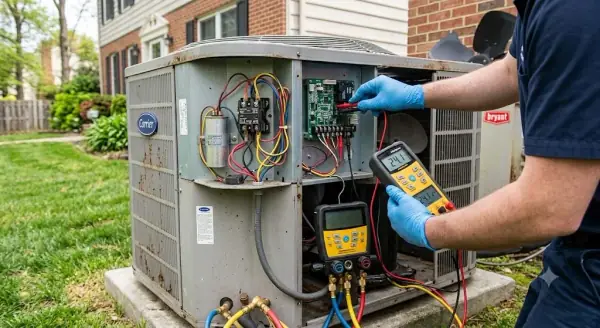
BCR Works technician using digital gauges and electrical testing tools on an outdoor heat pump diagnostic visit in Central Maryland.

Real-world electrical and refrigerant system diagnostic testing performed by a licensed BCR Works specialist.

Why Central Maryland Homeowners Trust BCR Works

πŸ”

Camera-Verified Diagnostics

We don't ask you to blindly trust us. We take clear photos and videos of failed parts so you see exactly what's broken before we touch a tool.

πŸ’°

No Hidden Pricing Surprises

We charge by the job, not by the hour. You receive a firm, straightforward, written price for approval before any repair work begins.

πŸŽ“

True Heat Pump Experts

Heat pumps operate differently than standard AC units. Our licensed technicians specialize in complex refrigerant flow and winter defrost sequences.

πŸ›‘ Sticker Shock From a Competitor's Repair Quote?

If another local HVAC company just left your house and dropped a massive, multi-thousand-dollar repair estimate on you, don't panic. Click your diagnosed component below to explore an honest, transparent breakdown of the part, real failure symptoms, and the exact questions to ask to verify if your quote is fair.

1. Compressor Replacement Guide ↓

The ultimate high-ticket repair vs. replace dilemma.

2. Stuck Mechanical Reversing Valve ↓

Verifying if your system truly needs major refrigerant surgery.

3. Thermostatic Expansion Valve (TXV) ↓

What a fair rate looks like when a primary circuit blocks flow.

4. Defrost Control Board ↓

Decoding the costs behind your heat pump's winter brain.

5. Auxiliary & Emergency Electric Heat ↓

Ensuring emergency backup heating grids aren't overpriced.

Have a Written Competitor Estimate in Hand Right Now?

Don't pay a blind premium. Text a clear photo of your technician's written diagnosis and invoice to 443-785-4822. We will audit the mechanical line items for free and provide a guaranteed, highly competitive second-opinion rate to fix it right.

Heat Pump Diagnostics & Consumer Protection FAQ

Real-world technical failure patterns, diagnostic guidelines, and competitor quote verification questions for Central Maryland homeowners.

1. How do I know if my heat pump compressor truly needs to be replaced?

The compressor is the mechanical heart of your outdoor unit, responsible for pumping and squeezing refrigerant under immense pressure. If a technician claims it is burned out electrically, demand to know if they performed a chemical acid test on the system oil. Burned-out motors release highly destructive acid into the loop. If a new compressor is dropped into an unflushed, acid-contaminated system without suction-line filters, the new unit will fail within weeks.

2. What are the symptoms of a stuck mechanical reversing valve?

The reversing valve slides internally to dictate your system's seasonal identity, allowing it to provide cooling in July and heating in December. When it gets physically stuck halfway, the heat pump loses capacity and often emits a continuous internal hissing sound. Before approving an expensive replacement, verify that your technician tested the external electrical solenoid coil for 24 volts and a functional magnetic pull. Replacing a dead external coil is inexpensive; do not pay for an invasive mechanical valve surgery if only the magnet is dead.

3. How does a Thermostatic Expansion Valve (TXV) failure affect my system?

The TXV micromanages a pinhole needle valve to deliver the perfect amount of liquid refrigerant into your indoor coils. If it gets stuck shut, it chokes off refrigerant flow, causing the indoor coil to rapidly freeze into a block of solid ice. Because a restricted TXV exhibits pressure profiles identical to a system low on charge, unequipped technicians often mistakenly add more refrigerant, which can overcharge and destroy the compressor. Insist that superheat and subcooling are verified using digital manifold probes.

4. Why is my outdoor heat pump turning into a solid block of ice in the winter?

Outdoor coils naturally gather frost while extracting heat from freezing Maryland air, which is why the defrost control board must regularly initiate a brief cycle to melt the ice. If the board fails, the unit will suffocate in a thick block of white ice. A competent technician will always test the outdoor temperature sensor with an ohmmeter first. A simple failed sensor can keep a perfectly good control board asleep, and replacing just the sensor saves you from buying an unneeded electronic circuit module.

5. How can I verify if my auxiliary electric heating elements are broken?

Auxiliary electric coils act like a giant toaster inside your indoor air handler to boost supply temperatures when outdoor winter drops fall below sub-freezing limits. If your emergency heating stops responding, the problem is frequently a failed auxiliary sequencer switch or a broken high-limit thermal safety cutout, rather than the expensive heavy-gauge wire bank itself. We measure exact electrical current draws across each individual heating stage to identify the precise failure point.

6. Why is my heat pump blowing lukewarm air instead of hot air in the winter?

Unlike a gas furnace that delivers high-temperature air blast cycles, a standalone heat pump produces a steady stream of milder supply air (typically 85Β°F to 92Β°F). While this air keeps your home warm, it can feel cool or lukewarm to human body touch (which rests at 98.6Β°F). However, if your indoor air temperatures are actively dropping, the system may have a low refrigerant charge, a failing outdoor fan motor, or non-functioning auxiliary heat strips.

7. What causes a heat pump to constantly cycle on and off (short-cycling)?

Short-cycling is frequently triggered by low system airflow caused by a severely clogged air filter or blocked return grilles, which forces high-limit safety switches to trip and shut down the system to prevent damage. Other common mechanical causes include a failing high-pressure switch, an overcharged or undercharged refrigerant loop, or a malfunctioning thermostat sensor that is detecting false local temperature readings.

8. Is it normal for my outdoor heat pump to make a loud clunking noise and hiss?

Yes, this occurs naturally during the winter defrost transition. When the internal control board shifts the reversing valve to clear ice from the outdoor coil, the sudden shift in refrigerant pressure produces a loud clunk and a distinct shifting hiss sound. The outdoor fan will also temporarily stop spinning, and you may see steam rising off the unit. This normal maintenance cycle should conclude within 10 minutes.

9. Why is my outdoor heat pump running continuously without ever turning off?

When outdoor temperatures drop below 35Β°F in Central Maryland, a standard heat pump must run almost continuously to keep up with your home's natural heat loss. This constant operation is highly efficient and designed by manufacturing standards. However, if the system runs constantly in mild spring or autumn weather while failing to maintain your thermostat setpoint, it indicates an underlying issue like low refrigerant charge or heavy auxiliary stage failures.

10. What is the difference between standard AC units and heat pump systems?

A standard central air conditioner is a one-way system built exclusively to extract heat from inside your home and release it outdoors. A heat pump uses an identical compression cycle but adds a specialized reversing valve and advanced seasonal metering controls, allowing it to reverse the flow of refrigerant completely. This dual capability enables it to pull heat out of your home in summer and pull ambient heat from outdoor air into your home during winter.

Understanding Your Heat Pump's Common Failure Points

A heat pump does more mechanical work than a standard air conditioner β€” the same equipment handles both heating and cooling by reversing the refrigerant cycle, which means there are a few extra components that can fail: the reversing valve, the defrost control board, and auxiliary electric heat. Most heat pump service calls in Central Maryland trace back to one of five areas: the compressor, the reversing valve, the TXV, the defrost board, or the auxiliary heat strips.

These failures often get treated as interchangeable by companies looking to sell a bigger repair than necessary β€” a stuck reversing valve and a dead compressor can sound similar to an untrained ear, but they cost very differently to fix. That's why BCR Works tests the specific component before recommending work on it, and why we've written a full diagnostic breakdown for each of the five areas above. If you've already gotten a quote from another company, those guides will help you understand exactly what should have been tested before that number was written down.

πŸ”„ Time for a Fresh Start? Zero-Pressure System Replacement

If your heat pump is over 10 to 12 years old, relies on obsolete R-22 refrigerant, or keeps breaking down, dumping thousands into a high-ticket mechanical repair is rarely a sound financial choice. BCR Works provides straightforward, zero-pressure system replacements. We properly size your equipment to match Maryland’s unique seasonal demands, ensuring lower utility costs and a comprehensive 10-year factory parts warranty. Homeowners comparing heat pump replacement options can also review ENERGY STAR’s heat pump efficiency guidance.

Get a Fast, Upfront Free Replacement Estimate

❄/πŸ”₯ Seasonal Tune-Ups That Actually Prevent Breakdowns

Most HVAC companies offer cheap "tune-ups" that amount to nothing more than a quick wipe down and a sales pitch. At BCR Works, our seasonal heat pump maintenance is a highly rigorous, technical inspection designed to catch hidden electrical and mechanical wear before it turns into an expensive middle-of-the-night emergency.

βœ”οΈ Electrical capacitance testing on run controls.
βœ”οΈ Cleaning and treating dirty outdoor condenser coils.
βœ”οΈ Verifying subcooling and superheat pressures.
βœ”οΈ Checking winter defrost sensor operations.
βœ”οΈ Measuring compressor running amp draws.
βœ”οΈ Inspecting high-voltage contactor surfaces.

Ready For Honest, Straightforward HVAC Service?

Whether you need an immediate diagnostic repair, a transparent second opinion on an expensive quote, a precision tune-up, or a full system upgrade, BCR Works is standing by to help.

Text Inquiries to: 443-785-4822 β€’ Serving Central Maryland Since Day One