
Thermostatic Expansion Valve (TXV) Failure: Second Opinion & Pricing Guide
Expert HVAC Solutions Across Harford, Baltimore, and Howard Counties
A clear second-opinion guide for Central Maryland homeowners who have been quoted for a TXV metering valve repair.
🛑 Stunned by a High Quote for a TXV Metering Valve Replacement?
If another local HVAC contractor just diagnosed your heat pump with a failed Thermostatic Expansion Valve (TXV), you are likely facing a substantial repair estimate. Because the TXV is buried deep within your indoor or outdoor coil housing and dictates the entire refrigeration cycle, replacing it is a highly technical, multi-hour surgical procedure. Before you hand over your hard-earned money, you deserve a transparent review to verify if the valve is genuinely restricted, or if a simpler system imbalance is mimicking the failure.
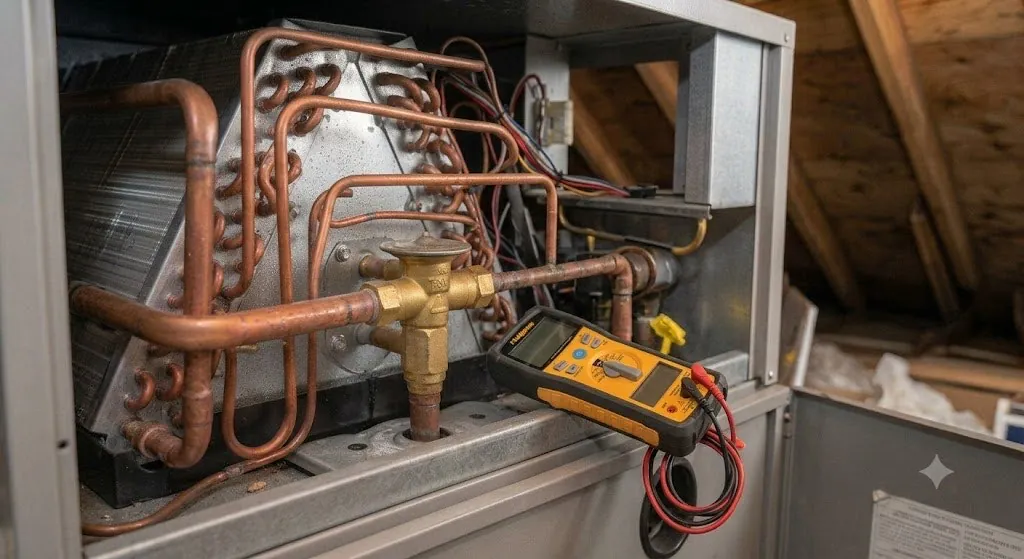
Real-world diagnostics measuring precise superheat and subcooling pressures at the TXV circuit loop.
💬 The Plain-English Translation: What Does It Do?
The Analogy: Think of the TXV as the automated traffic controller of your entire heat pump system. Its single job is to constantly measure the exact temperature of your coils and micro-adjust an internal pinhole needle valve. This regulates the precise amount of liquid refrigerant traveling through your coils. If it lets in too much refrigerant, it floods the system; if it doesn't let in enough, it starves it. When the valve fails or locks up mechanically, the flow of refrigerant completely chokes off.
🔍 Symptoms & Real-World Diagnosis
When a TXV restricts or freezes shut, it leaves behind unmistakable mechanical warning signs around your property:
- The Frozen Solid Coil: Your indoor air handler or outdoor unit rapidly builds up a thick, solid layer of ice, blocking all airflow and causing water to pool on your floor.
- The Constant Short-Cycling: The system starts up, runs for a minute or two while straining aggressively, and then abruptly shuts off on its high-pressure safety cutout switch.
- The Lukewarm Vent Output: The fans are spinning perfectly, but your home's registers blow weak, room-temperature air because the system cannot transfer thermal energy.
How a Professional BCR Works Technician Verifies the Failure:
A restricted or stuck TXV exhibits pressure symptoms that look identical to a system running low on refrigerant. If an unequipped technician keeps adding more refrigerant gas, they can dangerously overcharge the system and quickly destroy the compressor engine. At BCR Works, we connect precise digital manifold probes to test the exact superheat and subcooling levels. We physically check the thermal sensing bulb to prove the valve mechanism is truly dead before quoting a replacement in Towson or Ellicott City.
⚠️ The Secondary Risk: Compressor Liquid Slug-Back
Ignoring a malfunctioning TXV is incredibly risky. If a valve fails in the fully open position, it can flood your system with raw liquid refrigerant.
Don't wait on a risk like this — get it verified.
🔧 The "While We Are In There" Checklist
Replacing a TXV requires breaking the factory seal on your refrigeration loop. When BCR Works handles this in Baltimore County, we execute these critical steps:
- Liquid Line Filter-Drier Swap: We always install a brand-new factory filter-drier to capture any moisture or debris inside the lines before releasing the charge.
- Nitrogen-Purged Brazing: We continuously pump dry nitrogen gas through the copper lines while torch-welding to prevent toxic black carbon oxide scaling from forming inside your pipes.
- Surgical Vacuum Evacuation: We utilize a high-precision digital micron gauge to pull the sealed loop down to 500 microns, ensuring completely dry, moisture-free performance.
⚖️ The Big Dilemma: Repair vs. Replace?
- When to REPAIR: If your system is under 10 years old and the TXV part is fully covered under the manufacturer's warranty, a repair is highly practical. You are only responsible for the specialized labor, supplies, and fresh refrigerant weigh-in.
- When to REPLACE the system: If your equipment is well past its 10-year lifespan, runs on obsolete R-22 fluid, or the indoor coil itself is severely rusted and leaking, investing thousands in a new valve is an expensive band-aid. Your capital is much better spent upgrading to a modern system.
⏱️ Logistics & Expectations
- Availability: TXVs must precisely match your system's exact tonnage and refrigerant type. While we stock common universal valves, certain brands require an OEM Factory Sourced Order.
- Labor Intensity: This is a highly technical, closed-loop refrigerant surgery. It involves full charge recovery, un-brazing inside the tight coil cabinet, installing the delicate sensing bulb at the perfect angle, and recharging. Expect a precision 3 to 5-hour on-site operation.
What Does This Repair Typically Cost?
Typical price range for this repair: $1,000–$2,000, depending on your specific system and part accessibility. The exact number is confirmed during your diagnostic visit — we test the specific failure point before quoting, rather than guessing.
❓ Frequently Asked Questions (TXV Metering Valve)
Q: Can a TXV valve become unstuck without being replaced?
A: Occasionally, a valve restricts because of a chemical reaction or additive buildup (like compressor oil sludge). In rare scenarios, an un-clogging additive can break down the oil varnish and free the needle valve. However, if the internal mechanical spring has snapped or the external sensing bulb has lost its factory gas charge, the valve is mechanically dead and must be replaced.
Q: Why does my indoor unit turn into a solid block of ice when a TXV fails?
A: When the TXV gets stuck in a closed or restricted position, it drops the pressure of the remaining refrigerant inside the indoor coil below the freezing point. Any natural humidity in your Maryland home's air instantly condenses onto the copper fins and freezes solid. Within hours, the ice grows thick enough to completely block all airflow.
Q: Is it safe to run my heat pump in 'Emergency Heat' mode if the TXV is bad?
A: Yes, temporarily. Turning your thermostat to 'Emergency Heat' (Auxiliary Mode) completely bypasses the outdoor refrigeration circuit and relies solely on your indoor electric heating elements. While this will cause your electric bill to increase temporarily, it is the safest way to keep your house warm in the winter without risking severe damage to your compressor.