
Why Is My Upstairs So Hot While Downstairs Feels Comfortable?
An upstairs that stays hotter than downstairs usually points to heat gain, airflow balance, duct design, insulation, or equipment performance working together. This guide explains what you can safely observe and why diagnosis matters before assuming the AC is too small.
Serving Harford County, Baltimore County, and Howard County.
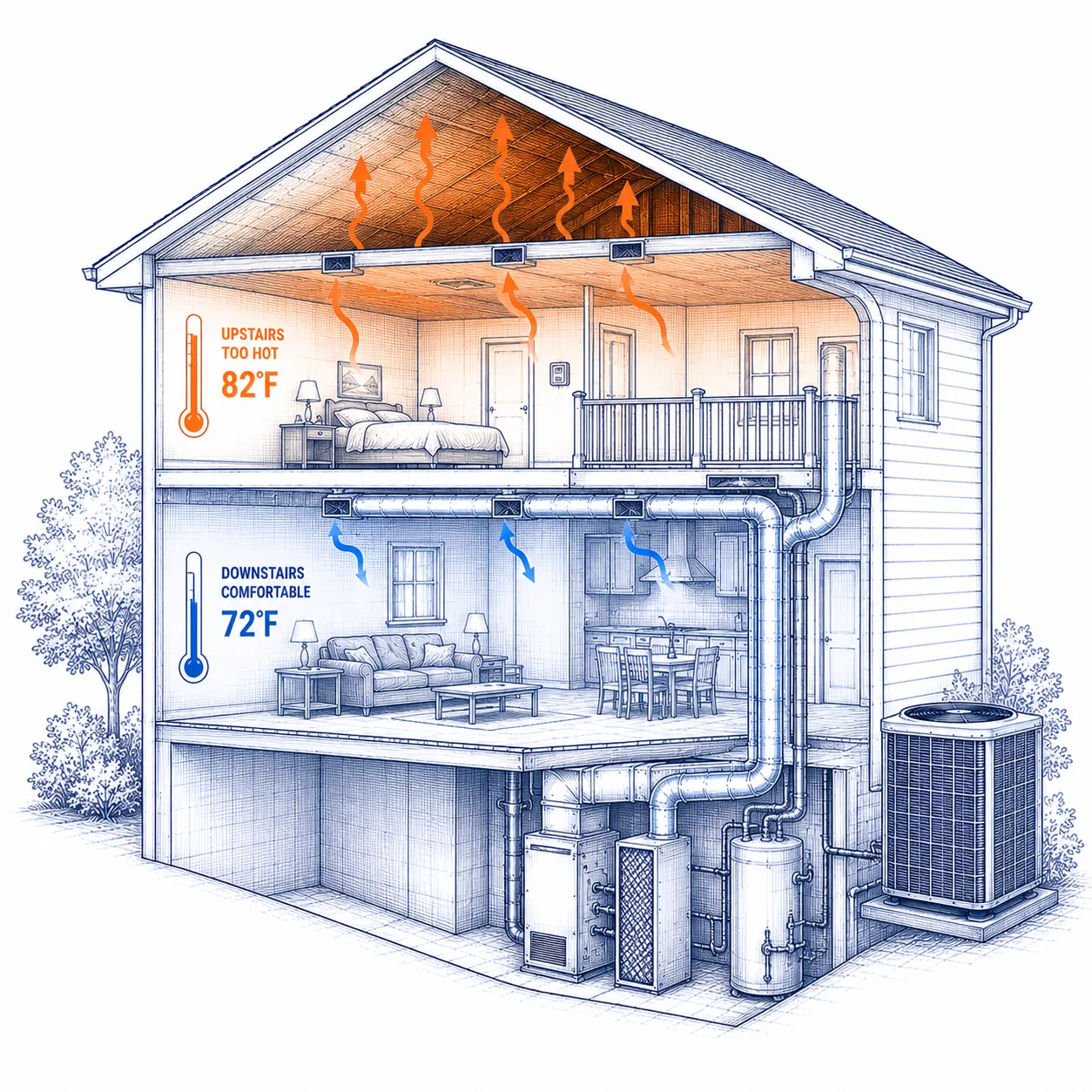
At a Glance
An upstairs that stays hotter than downstairs is common in two-story homes, but it should not be dismissed automatically. The upper floor usually receives more roof heat, attic heat, sun exposure, and humidity load while relying on ductwork that may not deliver or return air evenly.
Sun, attic temperature, insulation, and airflow all affect comfort.
A larger AC does not fix every airflow, duct, attic, humidity, or return-air problem.
Time of day, room pattern, airflow, filter condition, and humidity help narrow the next question.
How Upstairs Heat Builds Up
A second floor can stay warmer because it receives more heat while depending on airflow that may not be balanced with the load. The air conditioner may still be running, but the upstairs can keep gaining heat faster than comfort is restored.
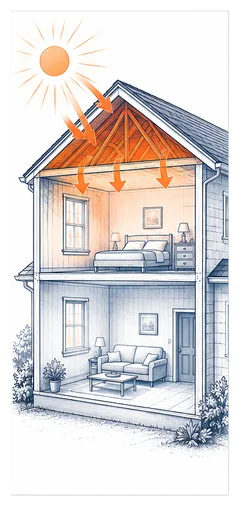
The upper floor usually receives the strongest roof and attic heat load.
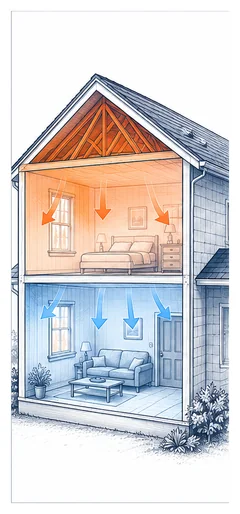
Ceilings, walls, windows, and attic conditions can add heat faster upstairs.
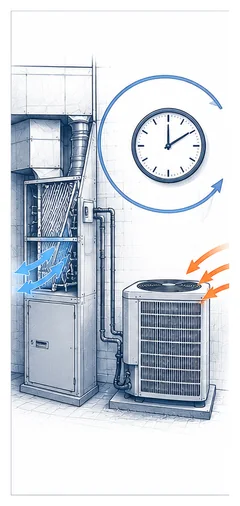
The system may run longer while airflow and heat load determine how much cooling reaches upstairs.
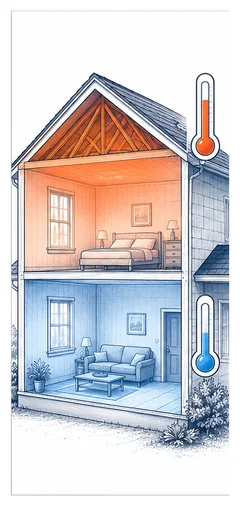
Downstairs may feel comfortable while the upper floor continues gaining or holding heat.
The next step is understanding whether the difference comes from normal load, duct delivery, return air, insulation, humidity, equipment performance, or a combination.
Quick Answer
Your upstairs may be hotter because the second floor gains more heat and may receive less effective airflow than downstairs. Common contributors include attic heat, sun exposure, duct leakage, poor duct design, restricted airflow, weak return air, closed doors, dirty filters, high humidity, thermostat location, insulation gaps, and equipment performance problems.
The practical goal is to determine whether the upstairs is warmer because of normal heat load, airflow imbalance, building conditions, equipment performance, or a combination. A second-floor comfort complaint is usually a pattern to investigate, not a single symptom that points to one guaranteed repair.
What can I safely check?
These observations help separate a normal second-floor temperature difference from a comfort problem that deserves evaluation.
Is every upstairs room warm, or mainly rooms above garages, under attic space, or facing afternoon sun?
Is upstairs worst in late afternoon or evening after the roof and attic heat up?
Do upstairs vents feel noticeably weaker than downstairs vents?
Do rooms become worse when doors are closed?
A dirty filter can reduce total airflow and make comfort problems more noticeable.
Does upstairs recover once the sun and attic temperature drop?
What should I avoid doing?
System size matters, but heat gain and airflow balance often matter just as much.
Closing vents can raise pressure, reduce airflow, and create new comfort or equipment problems.
A lower setting may increase runtime without correcting the upstairs airflow or heat-load issue.
Temperature difference is a clue. Diagnosis identifies the cause.
Why is my upstairs hotter than downstairs?
Second floors are exposed to conditions the first floor often avoids. The roof and attic absorb heat, sun-facing walls and windows add load, and warm air naturally tends to collect higher in the home. Even when the air conditioner is operating, the upstairs may be fighting a stronger heat load than downstairs.
Airflow is the other half of the equation. Supply vents deliver conditioned air into rooms, but that air also needs a way back to the HVAC system. When bedroom doors are closed and return paths are limited, upstairs rooms can become separated from the rest of the home. The room may have a supply register, but circulation can still be poor.
Many Central Maryland homes, especially older two-story and colonial-style homes, show this pattern during humid summer weather. The upstairs carries more solar load while the downstairs benefits from shade, lower heat gain, and sometimes stronger duct delivery.
Why does upstairs get worse later in the day?
Many upstairs comfort complaints follow the daily heat pattern of the home. The sun heats the roof and attic through the day. By late afternoon, attic surfaces, roof decking, walls, and sun-facing windows may still be radiating heat into the upper floor.
The air conditioner may be running normally and still have trouble catching up if the home keeps adding heat faster than the upstairs receives cooling. After sunset, the heat load often drops and the upstairs may begin to recover.
Can poor airflow cause this?
Yes. Upstairs comfort depends on both cooling capacity and air distribution. If the duct system does not deliver enough supply air upstairs, if return air is weak, if ducts leak, or if airflow is restricted by filters or equipment conditions, the upstairs may stay warm while downstairs feels fine.
Airflow problems can be subtle because the system still sounds like it is running. Registers may still blow air, but not enough air, not enough cool air, or not enough air in the right rooms.
| Condition | What It Means | Why It Affects Upstairs |
|---|---|---|
| Weak upstairs supply air | Not enough conditioned air reaches the second floor. | Rooms gain heat faster than cooling arrives. |
| Limited return path | Air cannot circulate back to the system easily. | Closed rooms can feel hot, still, or humid. |
| Duct leakage | Conditioned air is lost before reaching the room. | Upstairs receives less useful cooling. |
| Dirty filter | Total system airflow can drop. | Existing balance problems become more noticeable. |
| High humidity | The air feels warmer and comfort takes longer. | Upstairs can feel uncomfortable even with some cooling. |
A room can have a supply vent and still have poor circulation if air cannot return to the HVAC system.
Should I close downstairs vents to force more air upstairs?
Usually, random vent closing is not the best first step. Residential duct systems are designed to move a certain amount of air. Closing registers can increase duct pressure, reduce total airflow, make equipment operate less efficiently, and sometimes create noise or comfort problems in other rooms.
Small seasonal adjustments may be reasonable in some homes, but large changes should be made carefully. If upstairs comfort depends on closing many downstairs vents, the better question is why the airflow balance is not meeting the home’s load.
Do I need a larger air conditioner?
Not automatically. A larger system may not solve an upstairs comfort problem if the real issue is duct delivery, return air, attic heat, insulation, windows, humidity, or airflow restriction. Oversizing can also create its own comfort problems because short runtimes may reduce moisture removal.
Equipment size should be evaluated with the home, duct system, load, and measured performance in mind. If an existing system is older, poorly performing, or incorrectly sized, replacement may eventually be part of the conversation. But the conclusion should come from evidence, not from the upstairs temperature difference alone.
Can attic insulation or ductwork be part of the problem?
Yes. Attic insulation, air sealing, duct location, duct leakage, and duct insulation can all affect upstairs comfort. A system may be capable of producing cool air but still struggle if too much heat enters the upstairs or too much conditioned air is lost before reaching the rooms.
This is why second-floor comfort is a systems problem. The HVAC equipment, ductwork, attic, insulation, windows, doors, and humidity all interact. Repair-first thinking means measuring and observing before deciding whether the best next step is maintenance, airflow correction, duct evaluation, building-envelope improvement, equipment repair, or replacement planning.
When is this normal, and when should I be concerned?
| Often Normal | Deserves Evaluation |
|---|---|
| Upstairs is slightly warmer during extreme heat. | Upstairs remains uncomfortable every day. |
| The difference is worst during late afternoon sun. | The upstairs never recovers after sunset. |
| Some rooms with strong sun run warmer. | Airflow from upstairs vents feels weak. |
| Longer runtime during heat waves and humidity. | The system runs constantly but comfort does not improve. |
| Humidity makes upstairs feel warmer. | Warm air, ice, water, breaker trips, or abnormal noise appear too. |
Is my upstairs comfort problem normal?
This decision aid is educational. It helps homeowners think through the pattern without diagnosing the system from symptoms alone.
- Is upstairs only slightly warmer during extreme heat?
That can be normal, especially in two-story homes with heavy sun exposure.
- Does upstairs remain uncomfortable every day?
That pattern deserves evaluation of airflow, ductwork, insulation, humidity, and system performance.
- Are some rooms much worse than others?
Room pattern can point toward sun exposure, duct layout, return paths, or insulation differences.
- Are there other HVAC symptoms?
Warm air, ice, weak airflow, water, breaker trips, or unusual operation should be diagnosed professionally.
How BCR Works Diagnoses This
An experienced technician separates the comfort complaint into two broad questions: how much heat is entering the upstairs, and how well the HVAC system is moving conditioned air to and from those rooms?
Diagnosis may include airflow observations, supply and return temperature measurements, filter and coil condition, blower operation, duct layout, visible duct issues, return-air paths, thermostat location, humidity, equipment operation, and building conditions such as attic exposure or room orientation.
| Safe Homeowner Observation | Technician-Only Evaluation |
|---|---|
| Upstairs is several degrees warmer than downstairs. | Compare heat load, airflow, return paths, and cooling performance. |
| Airflow feels weaker upstairs. | Evaluate duct delivery, filter condition, blower operation, and static pressure where appropriate. |
| Rooms get worse with doors closed. | Evaluate return-air paths and pressure separation. |
| The system runs constantly but upstairs stays warm. | Measure temperature performance, airflow, refrigerant-side behavior, and heat load before recommending repairs. |
| The issue is worst in specific rooms. | Look at sun exposure, duct routing, insulation, windows, and room-by-room airflow. |
What information should I have before calling?
A few observations can make the service conversation more productive and help the technician understand the pattern.
How many degrees warmer is upstairs compared with downstairs?
Morning, afternoon, evening, or all day?
All upstairs rooms or specific bedrooms?
Do upstairs vents feel weaker than downstairs vents?
Does the issue change when doors are open?
Warm air, ice, water, breaker trips, unusual sounds, or high humidity.
What should I remember?
An upstairs that is hotter than downstairs is often the result of heat gain and airflow balance, not simply the size of the air conditioner. The second floor receives more roof heat, attic heat, sun exposure, and humidity load while depending on ductwork and return paths that may not be evenly balanced.
The right answer may be maintenance, airflow correction, duct evaluation, return-air improvement, thermostat strategy, insulation discussion, zoning discussion, equipment repair, or replacement planning. The best recommendation starts with understanding the pattern and measuring how the system is actually performing.
Remember This
An upstairs that’s warmer than downstairs is often the result of how heat moves through the home and how air moves through the system, not simply the size of the air conditioner.
About This Guide
This guide was written by BCR Works, a Maryland-licensed residential HVAC company with more than 25 years of field experience. Every guide is based on real-world residential HVAC diagnostic experience and follows our repair-first philosophy: symptoms are clues, and diagnosis comes before recommendation.
Our goal is to help homeowners understand how their HVAC systems work, recognize common symptoms, and know what they can safely observe before professional service is needed. These guides are educational resources and are not a substitute for an on-site diagnosis.
Need Local HVAC Help?
If your upstairs is hot while downstairs feels comfortable in Harford County, Baltimore County, or Howard County, BCR Works can evaluate airflow, cooling performance, humidity, and the conditions that affect second-floor comfort.