
Why Is My AC Humming but Not Starting?
A humming outdoor unit can sound like your air conditioner is trying to run but cannot finish starting. This guide explains what that sound can mean, what homeowners can safely observe, and why testing matters before assuming the capacitor is bad.
Serving Harford County, Baltimore County, and Howard County.
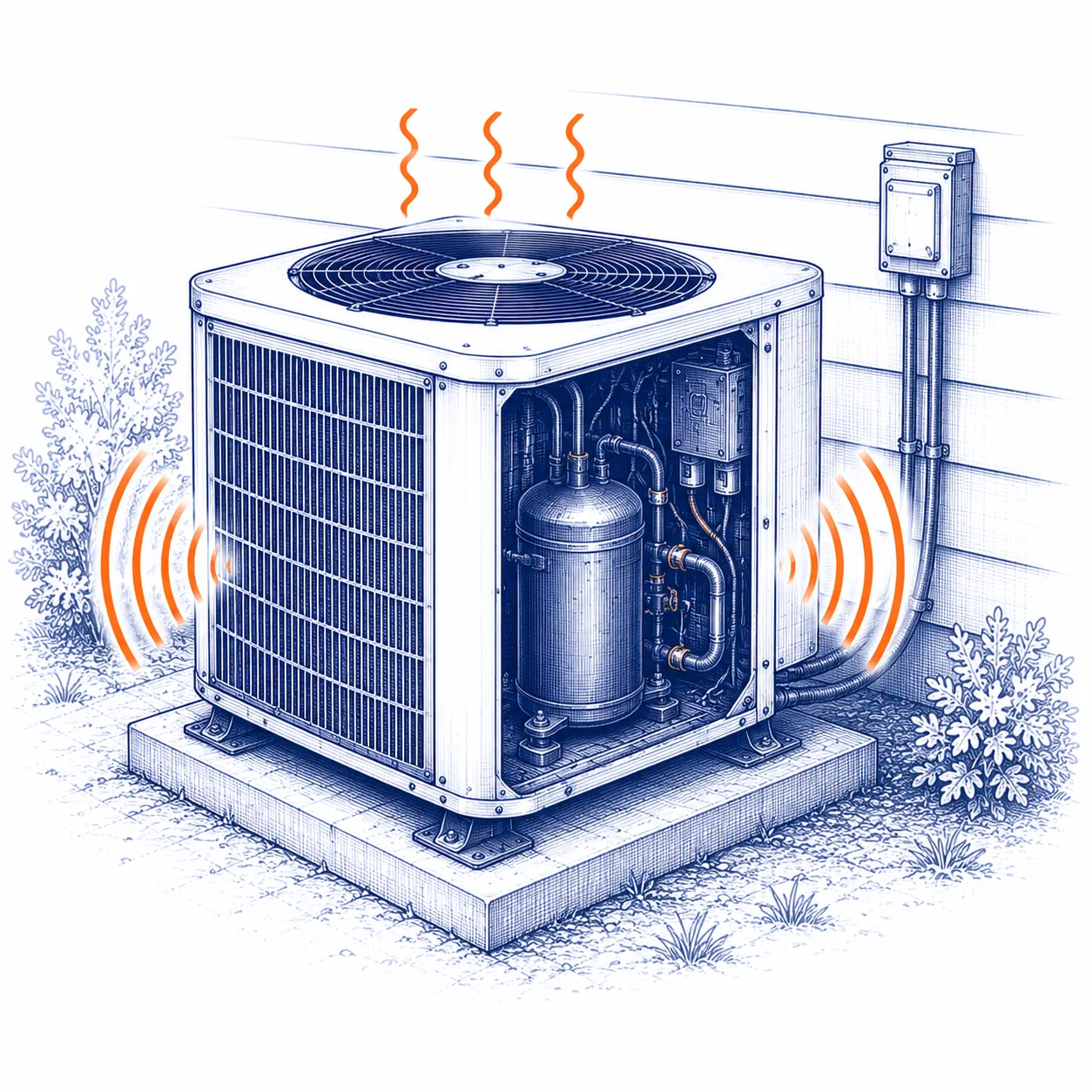
At a Glance
A humming sound usually means part of the air conditioner is energized and trying to start. The sound narrows the question to the starting sequence, but it does not identify the failed part by itself.
The outdoor unit may hum while the fan or compressor fails to run normally.
Capacitors, fan motors, compressors, contactors, controls, wiring, and mechanical binding can all be involved.
Safe observation helps. Testing identifies where the starting sequence stopped.
How an AC Starts
A humming outdoor unit usually means the system has reached the attempted-start part of the sequence. The sound is useful information, but it does not identify which electrical, mechanical, or control condition prevented the system from starting normally.
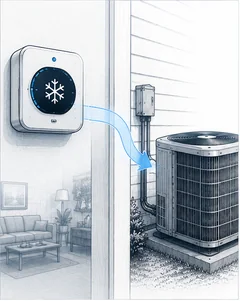
The thermostat requests cooling and begins the normal starting sequence.
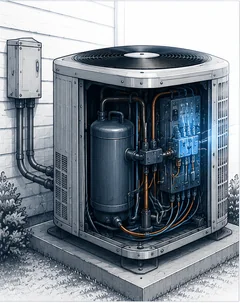
Electrical power reaches the outdoor unit and the system prepares to start.
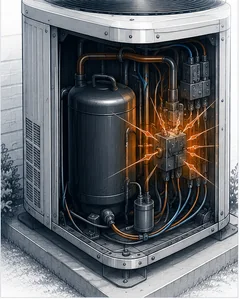
The compressor attempts to start but cannot complete the process.
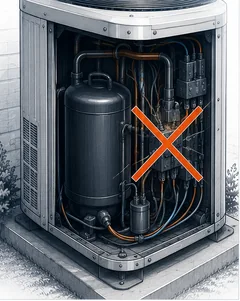
The system hums but does not run normally. The sound is a symptom, not the diagnosis.
The next step is finding where the starting sequence stops: power supply, controls, contactor, capacitor support, motor behavior, compressor operation, wiring, or mechanical binding.
Quick Answer
If your AC is humming but not starting, the system may be receiving power and attempting to start, but one part of the starting sequence is not completing. That does not automatically mean the capacitor is bad, even though capacitors are a common homeowner guess.
A humming outdoor unit can be related to start or run capacitor conditions, fan motor problems, compressor-related conditions, contactor issues, electrical controls, mechanical binding, wiring problems, or power supply concerns. The same basic sound can come from more than one situation.
If the system hums and does not start, do not keep lowering the thermostat, repeatedly resetting power, or pushing parts with tools. Turn cooling off and schedule professional diagnosis if the system will not start normally.
What can I safely check?
These checks are safe observations. They help describe the situation without turning the homeowner into the technician.
Confirm the thermostat is set to cooling and asking for a lower temperature.
Notice whether the hum comes from the outdoor unit, indoor unit, or electrical panel area.
From a safe distance, note whether the fan spins, twitches, or stays still.
Look only. If the breaker trips repeatedly, leave the system off.
Burning smell, smoke, or an electrical odor means the system should remain off.
Notice whether this happened after a storm, outage, thermostat change, or heavy cooling demand.
What should I avoid?
A fan can start unexpectedly, and the underlying starting problem still remains.
HVAC electrical compartments contain high voltage and stored electrical energy.
Repeated attempts can increase electrical and mechanical stress.
Capacitors, motors, compressors, controls, and wiring should be tested safely.
Why is my AC humming?
Humming usually means something is energized. A control may have pulled in, a motor may be trying to start, a contactor may be engaged, or a compressor may be attempting to run. The sound tells you energy is present somewhere in the starting process.
That is useful, but it is not enough to identify the repair. A fan motor that cannot start, a compressor that cannot start, a weak capacitor, a stuck contactor, low voltage, mechanical binding, damaged wiring, or a control problem can all produce some form of humming.
Why isn’t the fan spinning?
If the outdoor unit hums and the fan is not spinning, the fan motor, capacitor, contactor, wiring, controls, or mechanical condition of the fan assembly may need evaluation. The fan not moving is useful information, but it is still not a diagnosis.
Do not try to spin the blade with a stick, screwdriver, or hand. If the fan starts unexpectedly, it can injure someone. If it only starts after being pushed, the system still has a problem that needs proper testing.
| What You Notice | What It May Mean | Why Testing Matters |
|---|---|---|
| Fan stays still while the unit hums. | Fan motor, capacitor, power, or mechanical restriction may be possible. | Different causes can look similar from outside. |
| Fan twitches but does not run. | Starting support, motor condition, or voltage may matter. | Measurements show whether the motor is being supported correctly. |
| Fan runs but compressor does not. | The stop point may be compressor-related rather than fan-related. | The fan and compressor perform different jobs. |
| Humming is followed by a breaker trip. | Electrical load or fault conditions may be present. | The circuit should not be repeatedly reset. |
Can I safely reset anything?
If a breaker or disconnect has tripped, one reset may be tempting. But if the system hums, fails to start, or trips again, stop. Repeated resetting does not correct the cause and may keep exposing the equipment to the same fault.
Lowering the thermostat further is not a reset. It only keeps asking the system to start. If the outdoor unit is already humming but not starting, asking harder does not solve the problem.
A thermostat call is only a request. It does not prove the outdoor unit has the correct voltage, working controls, or healthy starting components.
Does humming always mean a bad capacitor?
No. Capacitor-related conditions can be involved because motors and compressors need proper electrical support to start and run. But humming should not be turned into a capacitor diagnosis without testing.
Several conditions can create similar symptoms: motor failure, compressor problems, wiring faults, contactor problems, control issues, mechanical binding, dirty coils, or power-supply concerns. A capacitor may be part of the diagnosis, but it should be measured rather than guessed.
Should I turn the system off?
If the outdoor unit hums without starting, the safest practical step is to turn cooling off and avoid repeated start attempts. This is especially important if the hum is loud, the fan is not spinning, the breaker trips, there is a burning smell, or the unit repeatedly tries and fails to start.
| Usually Lower Concern | Turn It Off and Schedule Service |
|---|---|
| A brief click or low sound before normal startup. | Continuous humming with no fan or compressor operation. |
| Unit starts and cools normally after the sound. | Humming repeats each time cooling is requested. |
| No smell, smoke, breaker trip, or loss of cooling. | Burning smell, buzzing, smoke, or breaker trip is present. |
| The sound does not return. | The outdoor fan stays still or only twitches. |
How BCR Works Diagnoses This
An experienced technician listens, but does not stop at listening. The sound helps locate the part of the sequence that deserves testing. Then measurements confirm voltage, control operation, capacitor condition, motor behavior, compressor starting behavior, wiring integrity, and whether a protective device is interrupting operation.
| Safe Homeowner Observation | Technician-Only Evaluation |
|---|---|
| The outdoor unit hums but does not start. | Test starting components, motor/compressor behavior, controls, and power supply. |
| The fan does not spin. | Evaluate fan motor, capacitor support, voltage, controls, and safe mechanical movement. |
| The unit hums briefly then stops. | Evaluate compressor start behavior, overloads, safeties, and electrical load. |
| The breaker trips during humming. | Test for shorts, grounded components, high current, and start failures. |
| There is a burning smell or visible damage. | Leave the system off and inspect wiring, controls, terminals, and affected components safely. |
What should I do if my AC is humming?
This decision aid is educational. It helps homeowners understand when to stop trying to run the system and schedule service.
- Is there smoke, burning smell, buzzing, or visible damage?
Leave the system off and schedule service.
- Is the outdoor fan not spinning?
Do not touch or push the blade. Turn cooling off if the unit will not start normally.
- Does the hum repeat each time cooling is requested?
Stop repeated attempts and arrange diagnosis.
- Did the system start normally after one brief sound?
Continue observing. A brief startup sound is different from humming without starting.
What should I note before calling?
Outdoor unit, indoor unit, thermostat area, or electrical panel?
Does the outdoor fan spin, twitch, or stay still?
Did the breaker trip once, repeatedly, or not at all?
Does the system cool at all after the hum?
Does it happen immediately, after a delay, or only during very hot weather?
Storms, outages, electrical work, thermostat changes, or maintenance can matter.
What should I remember?
A humming air conditioner is usually trying to start, but the sound alone does not prove why it cannot complete the process. The cause may be capacitor-related, motor-related, compressor-related, control-related, mechanical, or tied to power supply conditions.
Do not keep trying to force the system to start. Safe observations are useful, but testing should determine the actual cause before parts are replaced.
Remember This
A humming sound means the system is trying to start. It does not explain why the starting sequence cannot complete.
About This Guide
This guide was written by BCR Works, a Maryland-licensed residential HVAC company with more than 25 years of field experience. Every guide is based on real-world residential HVAC diagnostic experience and follows our repair-first philosophy: symptoms are clues, and diagnosis comes before recommendation.
Our goal is to help homeowners understand how their HVAC systems work, recognize common symptoms, and know what they can safely observe before professional service is needed. These guides are educational resources and are not a substitute for an on-site diagnosis.
Need Local HVAC Help?
If your air conditioner is humming but not starting in Harford County, Baltimore County, or Howard County, BCR Works can evaluate the starting sequence, electrical controls, motor behavior, compressor operation, and equipment condition before recommending the next step.