
Why Does My AC Keep Turning On and Off? (Short Cycling)
If your air conditioner keeps starting and stopping before your home is comfortable, it may be short cycling. This guide explains what that means, what you can safely observe, and why diagnosis should come before assuming one failed part.
Serving Harford County, Baltimore County, and Howard County.
At a Glance
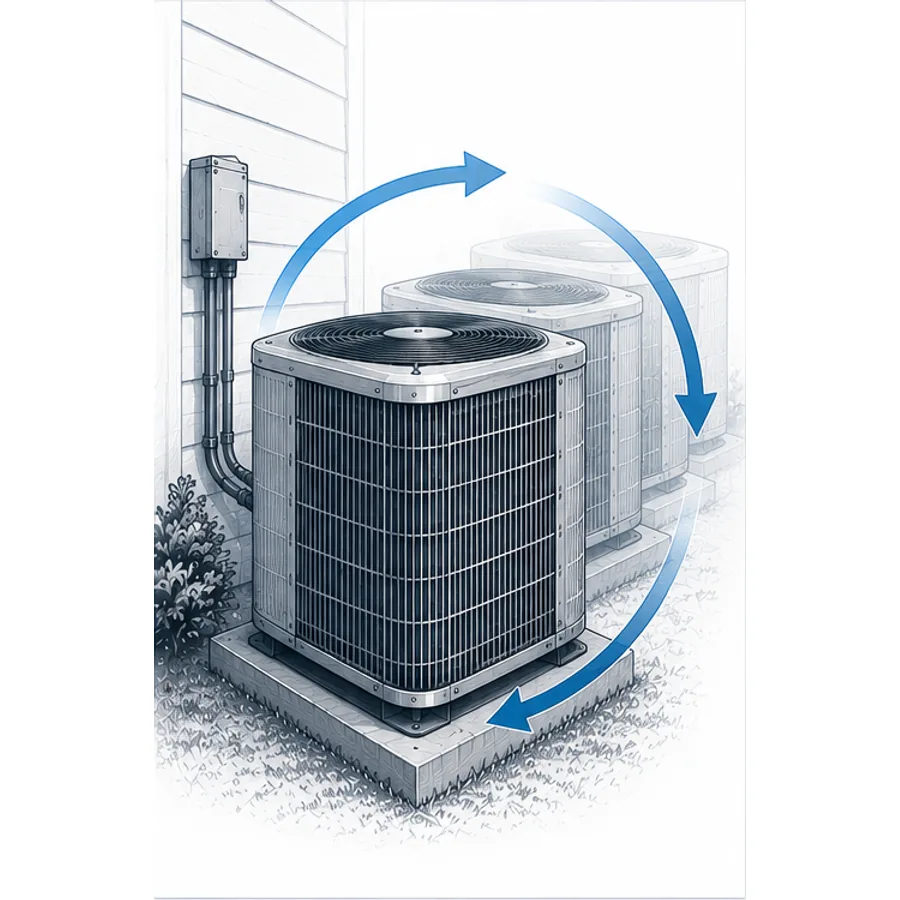
Short cycling means the air conditioner starts and stops before completing a normal cooling cycle. It is a symptom, not a diagnosis.
It may start, run briefly, stop, then repeat before the home reaches the thermostat setting.
The system may not remove enough heat or humidity, and repeated starts can add stress.
Runtime, airflow, thermostat behavior, safeties, and equipment operation all matter.
How Short Cycling Happens
A normal cooling cycle needs enough runtime to remove heat and moisture. Short cycling cuts that process short, then asks the equipment to start again before the home has actually caught up.
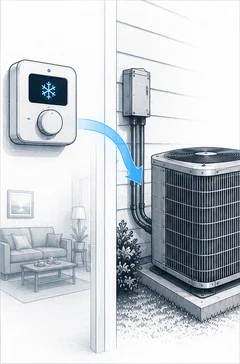
The thermostat asks the air conditioner to begin a normal cooling cycle.
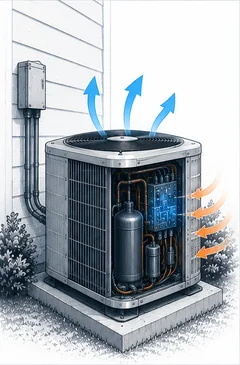
The equipment begins running and starts moving heat out of the home.
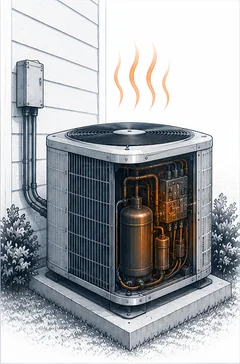
The cycle ends before enough heat and humidity have been removed.
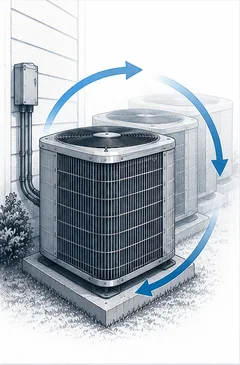
The system starts again before the home reaches the thermostat setting.
Short cycling interrupts heat removal, humidity removal, and stable comfort. The next step is finding what is ending the cycle too soon.
Quick Answer
If your AC keeps turning on and off, it may be short cycling. That means the system is not running long enough to complete a normal cooling cycle before it shuts down and starts again.
Short cycling can be connected to airflow restrictions, thermostat location or settings, control problems, condensate safety switches, frozen coils, refrigerant-related conditions, electrical issues, equipment sizing, or other system conditions. The repeated start-stop pattern is the clue. Testing identifies the cause.
In Central Maryland, high humidity can make short cycling especially noticeable because the air conditioner needs enough runtime to remove moisture as well as heat.
What can I safely check?
These checks are observations. They help describe the pattern without opening equipment or guessing at the repair.
Notice whether each cycle lasts a few minutes or long enough to cool the home.
Watch whether the equipment restarts quickly after shutting off.
Note whether the thermostat is still calling for cooling when the equipment stops.
A dirty filter can restrict airflow and contribute to operating problems.
Notice whether the house reaches the thermostat setting or keeps falling behind.
Visible ice, water around equipment, or repeated breaker trips should be noted before service.
What should I avoid?
Lowering the setpoint repeatedly does not explain why the cycle is ending early.
HVAC electrical compartments contain high voltage and stored electrical energy.
A breaker trip is a safety event and should not become part of normal operation.
Short cycling can have several causes. Testing should identify what interrupted the cycle.
What is short cycling?
Short cycling is when the air conditioner starts and stops more often than it should. Instead of running a steady cycle that removes heat and humidity, the system shuts off early and then starts again.
A short cycle can happen quickly enough that the home never feels stable. The system may sound busy, but the useful cooling time is limited.
Why does short cycling happen?
Short cycling happens when something ends the cooling cycle before the thermostat is satisfied. Sometimes that is related to airflow. Sometimes it is a control issue. Sometimes a safety device is stopping operation because another condition exists.
That is why the same symptom can point to very different repairs. The diagnosis begins by finding what stopped the cycle, then testing why.
| Possible Category | What It Means | Why It Can Cause Short Cycling |
|---|---|---|
| Airflow restriction | Air is not moving properly through the system. | The equipment may overheat, freeze, or reach a limit condition. |
| Thermostat or controls | The call for cooling may be interrupted or poorly located. | The system may shut off before the home is actually comfortable. |
| Condensate safety | Water backup may trigger a float switch. | The system may stop to prevent overflow. |
| Electrical or component operation | A motor, capacitor, contactor, compressor, or safety may not operate normally. | The system may start, stop, and retry. |
| Equipment sizing or load | The system may not be matched well to the home or current conditions. | Runtime can become unstable or comfort may never settle. |
Can a thermostat cause short cycling?
Yes, a thermostat or control issue can contribute to short cycling, but the thermostat should not be blamed just because the system starts and stops. Location, settings, loose control wiring, short cycle protection, and equipment safeties can all affect what the thermostat appears to be doing.
A thermostat near a supply register, sunny wall, appliance, or draft may sense conditions that do not represent the rest of the home. A technician also has to confirm whether the equipment stopped because the thermostat ended the call or because the equipment interrupted itself.
The thermostat asks for cooling. It does not prove the system completed the cooling cycle.
Can an oversized air conditioner short cycle?
It can. An oversized system may cool the air near the thermostat quickly and shut off before enough air has moved through the home. That can leave rooms uneven and humidity higher than expected.
But sizing is not the only possible cause. A dirty filter, frozen coil, control issue, drainage safety, refrigerant-related condition, or electrical problem can also create short cycling. Sizing should be evaluated only after the system’s basic operation has been tested.
Should I turn the system off?
If the system is short cycling repeatedly, turn cooling off and schedule service if the pattern is sudden, frequent, paired with weak airflow, visible ice, water around equipment, repeated breaker trips, or a burning smell.
If cycles are simply longer or shorter during changing weather, that may not be the same as short cycling. The concern is repeated start-stop operation before the home has a chance to cool normally.
| Often Normal Cycling | Concerning Short Cycling |
|---|---|
| The AC runs longer on very hot or humid days. | The AC shuts off after only a few minutes, then restarts repeatedly. |
| The home reaches the thermostat setting. | The home never reaches the thermostat setting. |
| Cycles change with outdoor temperature and indoor load. | Cycles are short even during mild conditions. |
| No ice, water, smell, or breaker issue is present. | Ice, water, burning smell, or breaker trips appear with the cycling. |
How BCR Works Diagnoses This
An experienced technician starts by confirming the pattern. How long does the system run? What stops first? Is the thermostat still calling? Is airflow normal? Is a safety switch interrupting operation? Are temperatures, pressures, electrical readings, and controls consistent with a normal cycle?
The goal is to find which part of the cooling cycle is being interrupted, then test why. That protects homeowners from replacing random parts when the actual issue may be airflow, controls, drainage, electrical operation, refrigeration performance, or equipment sizing.
| Safe Homeowner Observation | Technician-Only Evaluation |
|---|---|
| The system runs for only a few minutes. | Measure runtime, thermostat call, temperature split, safeties, and equipment response. |
| Airflow feels weak. | Evaluate filter, blower operation, coil condition, duct restrictions, and static pressure where appropriate. |
| The thermostat still calls after shutdown. | Check whether an equipment safety, control, or electrical condition ended the cycle. |
| Ice or water appears. | Evaluate airflow, coil temperature, refrigerant-side conditions, condensate drainage, and safety switches. |
| The breaker trips during cycling. | Test electrical load, wiring, motors, compressor behavior, and circuit protection safely. |
Is my AC short cycling?
This decision aid is educational. It helps homeowners describe the pattern without trying to diagnose the equipment.
- Does the AC run only briefly before shutting off?
Note the approximate runtime and whether the thermostat is still calling.
- Does it restart again quickly?
A repeated start-stop pattern is more concerning than one isolated short cycle.
- Does the home fail to reach the thermostat setting?
That suggests the cycles may not be long enough to remove heat and humidity.
- Do you see ice, water, breaker trips, or weak airflow?
Turn cooling off and schedule service rather than continuing to run the system.
What should I note before calling?
About how long does each cooling cycle last?
How quickly does the system start again after shutting off?
Is the thermostat still calling for cooling when the system stops?
Does the home reach the thermostat setting?
Ice, water, weak airflow, unusual smell, or breaker trips?
New thermostat, changed filter, storm, outage, maintenance, or recent repair?
What should I remember?
Short cycling means the air conditioner is not completing normal cooling cycles. It may still start and run, but it is not staying on long enough to remove enough heat and humidity.
The cause should not be guessed from the pattern alone. Safe observations help describe what is happening, but diagnosis should identify why the cycle is being interrupted.
Remember This
An air conditioner cools best when it runs long enough to complete a normal cooling cycle. Frequent starts and stops are often a sign that something deserves attention.
About This Guide
This guide was written by BCR Works, a Maryland-licensed residential HVAC company with more than 25 years of field experience. Every guide is based on real-world residential HVAC diagnostic experience and follows our repair-first philosophy: symptoms are clues, and diagnosis comes before recommendation.
Our goal is to help homeowners understand how their HVAC systems work, recognize common symptoms, and know what they can safely observe before professional service is needed. These guides are educational resources and are not a substitute for an on-site diagnosis.
Need Local HVAC Help?
If your air conditioner keeps turning on and off in Harford County, Baltimore County, or Howard County, BCR Works can evaluate the cooling sequence, airflow, thermostat operation, safety controls, electrical behavior, and equipment performance before recommending the next step.