
Why Won’t My Furnace Filter Come Out?
You expected the filter to slide out in a few seconds. Instead, it moved a little, jammed solid, or started tearing apart. Before pulling harder, it helps to understand why furnace filters become physically stuck. In many cases, the filter itself is not the real problem.
Serving Harford County, Baltimore County, and Howard County.
Short Answer
A furnace filter that will not come out is usually physically stuck because its cardboard frame has caught on the metal opening, it was forced into a slot that is slightly too small, it bowed or swelled while in service, or the filter rack is pinching or obstructing it.
Set the thermostat to Off and wait for the blower to stop completely before touching the filter. Use only light, straight hand pressure through the normal filter access. If the filter begins tearing, the cabinet flexes, or removal requires tools or furnace-panel access, stop and request service.
Airflow can hold or deform a filter while the blower is running.
One stuck corner suggests a different physical problem than an entire frame that feels uniformly tight.
More force can turn a simple fit problem into damaged sheet metal or filter debris inside the system.
What Does Your Stuck Filter Look Like?
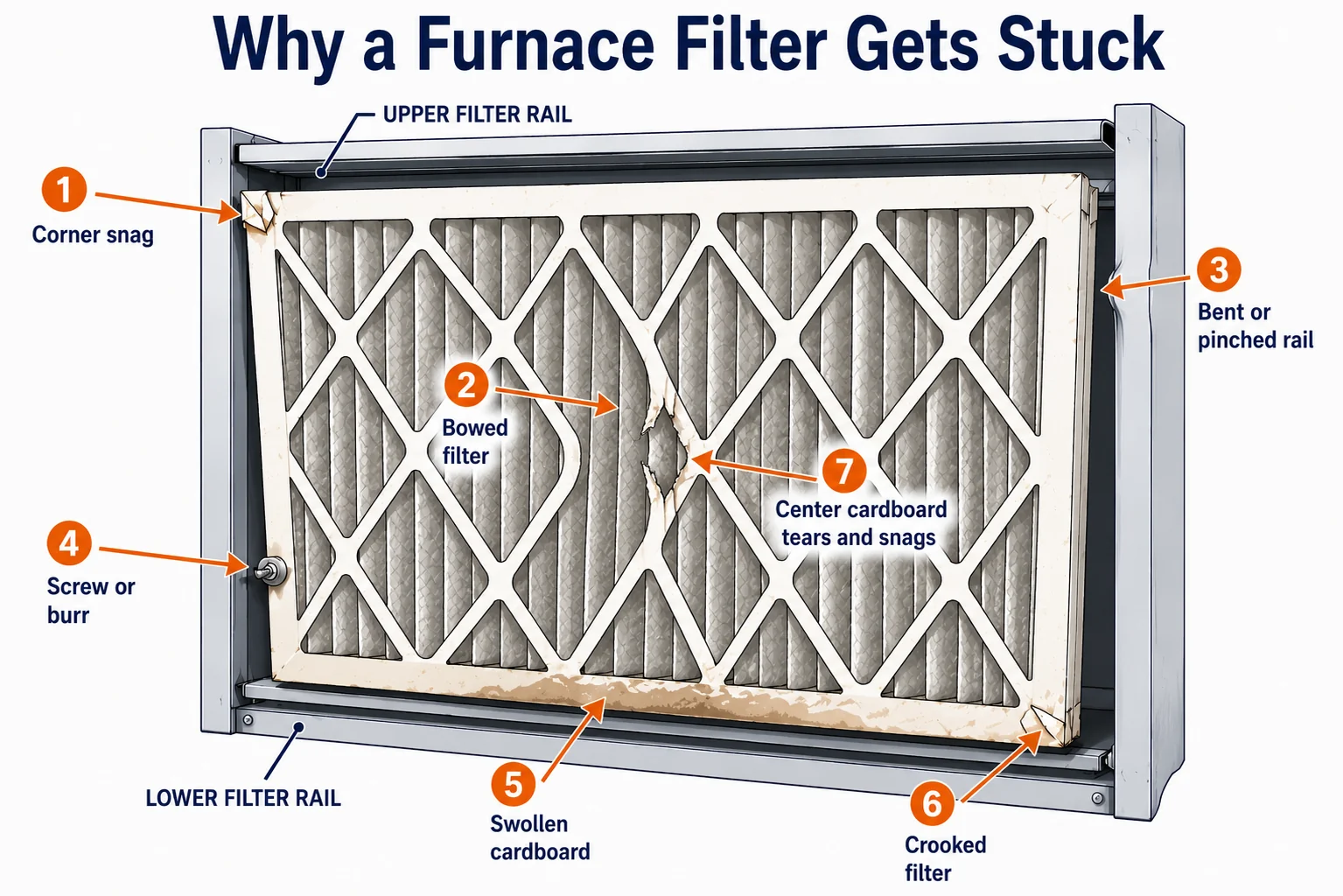
The illustration above combines several physical patterns BCR Works encounters in residential filter racks. Your filter may show only one of them.
The cardboard may be caught on the filter-slot edge, a rail, or a small obstruction.
A loaded or weakened filter may have bowed toward the blower while the system operated.
The actual filter dimensions may be too large, or the cardboard may have swollen.
The filter may be crooked or riding outside one of its intended rails.
A screw, burr, folded tab, or damaged edge may be in the withdrawal path.
Cardboard, media, or support material may have torn and remained inside.
Why Did It Go In but Won’t Come Back Out?
A filter can appear to fit when installed and still become difficult to remove later. The fact that it went into the opening does not prove that it was the correct fit or that the rack held it properly while the system operated.
- It was already slightly oversized. The frame compressed enough to enter but remained tightly wedged against the rack.
- The cardboard absorbed moisture. A frame that fit while dry can swell, soften, and drag against metal.
- The filter bowed in service. Loading and airflow can pull a weak filter out of its original flat shape.
- It shifted off-center. One edge can move out of its track or ride over a retaining rail.
- The rack pinched it. Bent or misaligned rails may grip the filter after it is fully inserted.
- A corner caught during removal. A filter that entered straight can twist when one corner is pulled first.
Most Common Real-World Causes
1. The cardboard frame catches on the filter slot
One of the most common patterns BCR Works sees is a thin cardboard corner catching on the edge of the filter opening during removal. One side moves, the opposite side stays fixed, and the frame begins to flex. Pulling harder usually folds the corner farther into the edge.
With the system off and blower stopped, you may use light hand pressure to return the filter slightly to its original position, square the visible frame, and try one slow, straight movement. Stop if the cardboard folds, tears, or immediately jams again.
2. The filter was forced in
Two filters can carry the same nominal size while having slightly different actual dimensions. A different brand may use a thicker frame or measure closer to the nominal dimensions. If the entire filter feels uniformly tight—or it was difficult to install—it may simply be too large for the opening.
Do not force the replacement into the same slot. Record the printed size and brand so the actual dimensions and rack opening can be compared.
3. The filter bowed while the system operated
A heavily loaded, weak, or poorly supported filter can bow toward the blower. Its edges remain in the rails while the center moves out of plane, changing the way the frame sits in the track.
A bowed filter is a clue, not proof of one airflow problem. Filter loading, support, rack design, and system pressure may all require evaluation.
4. The filter was installed crooked
One corner may enter the track while the opposite edge rides over or outside the rail. The filter still appears to go into place, but it sits diagonally and becomes wedged during removal.
If the visible frame cannot be squared with light hand pressure, stop. Twisting one corner until the filter collapses can leave debris inside the system.
5. The cardboard is wet or swollen
Moisture can soften and swell a cardboard frame. Instead of sliding smoothly, the edge drags, ripples, and deforms. Water marks, soft cardboard, musty odor, or nearby rust make the moisture source more important than simply installing another filter.
Do not reinstall a wet disposable filter. Leave the system off if the moisture source is unknown.
6. The filter rack is bent or pinched
If every filter binds in the same place, BCR Works starts looking at the rack instead of blaming the disposable filter. Rails can be bent inward, misaligned, or damaged by previous force or poor fabrication.
A replacement should not be forced into a rack that cannot accept and release it normally.
Other Causes We Occasionally Find
A fastener, folded tab, rough cut, or damaged piece of sheet metal can snag cardboard or media at one repeatable point.
Airflow can hold the filter against the rack or pull a weakened frame out of shape. Always wait for the blower to stop.
Some filters use brackets, upper and lower rails, hinged return grilles, or deep-media cabinets and are not designed to pull straight out.
The visible cardboard edge may come out while media, support wire, or another frame section remains inside.
A wall, pipe, door, water heater, framing, or renovation may block the filter before it clears the cabinet.
A crushed corner, bowed frame, or shipping damage can create immediate binding even when the printed size appears correct.
Quick Recognition Guide
| What You Notice | More Likely Physical Pattern | Safe Direction |
|---|---|---|
| One side moves and one side does not | Caught corner, crooked installation, or bent rail | Return it gently to square; stop if it folds or tears. |
| The entire filter is uniformly tight | Actual-size mismatch or swollen frame | Do not force it or the replacement. |
| The filter curves toward the furnace | Loading, airflow pressure, or weakened frame | Turn the system off and observe its visible shape. |
| It catches at exactly one point | Screw, burr, tab, or damaged edge | Stop before the frame tears; do not insert tools. |
| The frame is soft or discolored | Moisture exposure | Leave the system off and identify the moisture source. |
| Cardboard comes out without the complete filter | Torn or collapsed filter | Do not reach inside or operate the system. |
| Resistance changes when the blower stops | Airflow was holding or deforming the filter | Handle the filter only after the blower stops. |
| The filter cannot clear a wall or pipe | Inadequate service access | A permanent access correction may be required. |
What Can I Safely Do?
Wait until the blower stops completely before touching the filter.
Do not remove furnace panels to search for another path.
Capture its position, printed size, arrow, visible damage, and the edge that catches.
Note whether it is bowed, wet, torn, crooked, or uniformly tight.
Keep the pull slow, straight, and even. Return a caught corner slightly to square it.
Stop before the frame or cabinet is damaged so the actual cause can still be identified.
What Should I Avoid?
More force can fold the frame and tighten the wedge.
Screwdrivers, knives, pliers, hooks, and pry bars can damage sheet metal or expose internal hazards.
A torn filter can leave media, wire, or cardboard inside the system.
Internal electrical, fuel, combustion, and moving components require qualified service.
Unfiltered operation can allow debris to reach the blower and other internal components.
Identify why the previous filter stuck before repeating the same problem.
When Should I Stop and Request Service?
Stop normal homeowner handling when:
- The cardboard begins tearing or separating from the media.
- The rack or cabinet flexes.
- The filter is wet and the source is unknown.
- A sharp edge, exposed wiring, moving equipment, or blower compartment becomes accessible.
- Part of the filter remains beyond the normal opening.
- Removal requires a tool or furnace-panel disassembly.
- A replacement filter will not slide into the rack normally.
How BCR Works Solves the Problem
We first identify why the filter became stuck. Whenever possible, we remove it without damaging the furnace cabinet or filter rack. We inspect the rack, rails, access opening, filter dimensions, moisture conditions, and any place the frame may have caught or shifted.
Before the job is complete, we verify that the replacement filter fits correctly, follows the intended airflow direction, and can be removed normally. If a bent rack, sharp edge, obstruction, moisture problem, or access issue caused the filter to stick, we recommend a permanent correction instead of forcing another filter into the same problem.
Learn more about Gas Furnace Services, HVAC Diagnosis & Second Opinions, HVAC Maintenance, and The Works.
What Should I Check After the Filter Comes Out?
Confirm that the entire cardboard perimeter came out.
Confirm that no visible media, lattice, or support material is missing.
From the normal access, look for moisture, rust, or water marks.
Compare the replacement’s actual dimensions—not only the large nominal label.
The new filter should enter without crushing, bending, or force.
The arrow should point toward the furnace or air handler.
If the old filter is incomplete, wet, severely bowed, or torn—or the replacement does not slide normally—stop and request service.
What Should I Remember?
If changing the filter has become a struggle, do not assume that is normal. A filter that repeatedly sticks is often telling you something about the filter, the rack, the service opening, or the HVAC system itself. Finding and correcting the underlying reason is the best way to prevent the problem from returning.
Throughout this guide, references to common causes reflect BCR Works’ residential service experience. Published studies ranking the causes of physically stuck furnace filters are limited.
Related Resources
Stop before the filter or cabinet is damaged.
BCR Works can identify the obstruction, remove the filter carefully, and correct the condition that caused it to stick.