
Why Is My Furnace Short Cycling?
A furnace that starts and stops every few minutes may be responding to restricted airflow, thermostat conditions, overheating, an interrupted ignition or venting sequence, a control problem, or equipment sizing. A few causes are safe to check from outside the equipment; the rest require professional diagnosis.
Serving Harford County, Baltimore County, and Howard County.
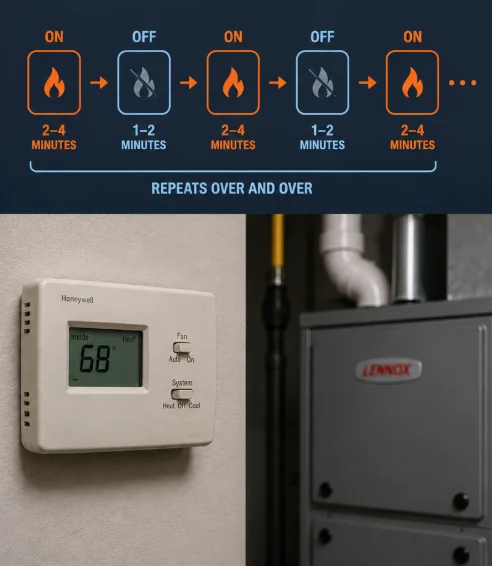
Short Answer
Furnace short cycling means the furnace repeatedly starts and stops before completing a normal heating cycle. Homeowners often describe it as a furnace that runs for only a few minutes, shuts off, and then starts again without properly warming the home.
Common possibilities include a dirty or overly restrictive air filter, blocked airflow, thermostat location or programming, furnace overheating, interrupted ignition, flame-sensing or venting problems, control faults, and equipment that is not well matched to the home. Some basic conditions are safe to check. The cause cannot be confirmed from cycle timing alone.
These can be reviewed without opening the furnace or using tools.
Repeated brief runs with little temperature improvement deserve attention.
Testing should identify why the heating sequence is ending early.
Common Reasons a Furnace Short Cycles
The most useful first distinction is whether the condition comes from something visible and safe to correct outside the equipment or from an operating condition that requires instruments and professional testing.
Safe homeowner checks
A restricted filter, thermostat setting or location, closed supply registers, blocked return grilles, or a recent programming change can affect airflow or the call for heat. These are reasonable places to begin because they can be checked without opening the furnace.
Conditions that usually require professional diagnosis
The furnace may be overheating and opening a safety limit, losing a stable flame signal, failing to complete ignition, encountering a pressure-switch or venting condition, receiving an interrupted control signal, or cycling because of equipment capacity and building load. These conditions can look similar from the living space and should not be assigned to a failed part without testing.
If the simple checks do not reveal an obvious issue, the cycle keeps repeating, or the home is not warming, schedule professional HVAC diagnosis.
Safe Homeowner Checks
Turn your attention to conditions you can verify without removing furnace panels, handling wiring, or resetting safety controls.
A dirty, collapsed, incorrectly sized, or overly restrictive filter can reduce airflow. Check an accessible filter for visible loading, damage, correct fit, and whether it is overdue for replacement. Stop if filter access requires opening the furnace cabinet or the filter is physically stuck.
Confirm Heat mode, a reasonable setpoint, Auto fan, the displayed room temperature, and the active schedule. Direct sunlight, a nearby supply register, drafts, or heat-producing electronics can cause the thermostat to sense a temperature that does not represent the room.
Make sure normal supply registers are open and not covered by furniture, rugs, or belongings. Check that return grilles are unobstructed. Do not remove grilles, enter ductwork, or make airflow modifications.
Review recent schedule, setback, battery, mode, or setpoint changes. Return only settings you understand to their normal values. Stop if correction would require wiring, installer menus, or control replacement.
Conditions That Usually Require Professional Diagnosis
Many internal conditions can end a heating cycle early. Their visible symptoms overlap, so a homeowner generally cannot distinguish them safely from outside the furnace.
Professional diagnosis should determine which stage begins normally, which stage stops, whether a safety control is responding to a real operating condition, and what caused the interruption before any repair is recommended.
Furnace Overheating and High-Limit Operation
A furnace may shut the burners down if temperatures inside the equipment rise beyond the intended operating range. Restricted airflow is one possible contributor, but blower performance, duct conditions, equipment setup, and other factors may also matter.
A homeowner can check the accessible filter and visible room registers. Determining whether a high-limit safety is opening—and why—requires temperature, airflow, and electrical testing. Do not reset or bypass a limit control.
Ignition, Flame-Sensing, Pressure, and Venting Conditions
A furnace can begin a call for heat and then stop if it cannot establish or verify stable combustion or safely complete the required venting sequence. Depending on when the interruption occurs, the homeowner may notice brief burner operation, repeated attempts, clicking, or a shutdown before warm airflow is established.
Those observations help describe the sequence, but they do not identify a failed sensor, igniter, pressure switch, vent component, or other part. Combustion, fuel, venting, electrical, and safety-control testing belongs with a qualified professional.
Controls, Equipment Sizing, and Other Sequence Faults
Control-board inputs, thermostat signals, blower operation, electrical connections, and other sequence conditions can interrupt a cycle. A furnace that is oversized for the home may also satisfy the thermostat quickly under some conditions, although short run time alone does not prove improper sizing.
These possibilities require the complete system and building conditions to be considered together. Replacing a thermostat, sensor, control board, or furnace based only on repeated starts and stops risks treating the symptom instead of the cause.
Why Professional Diagnosis Matters
Short cycling is the behavior you can observe. It is not the diagnosis. A restricted filter, incorrect thermostat input, overheating condition, interrupted ignition sequence, venting problem, control fault, or capacity issue can all produce repeated starts and stops.
BCR Works evaluates the thermostat request and furnace sequence in operating order, then follows the evidence with the appropriate temperature, airflow, electrical, combustion, and control testing. The goal is to identify the condition before recommending work. Learn more about Gas Furnace Services, Residential HVAC Services, HVAC Maintenance, and The Works.
Observations That Help Explain the Problem
You do not need to diagnose the furnace. A few simple observations can help a technician understand where the cycle is ending.
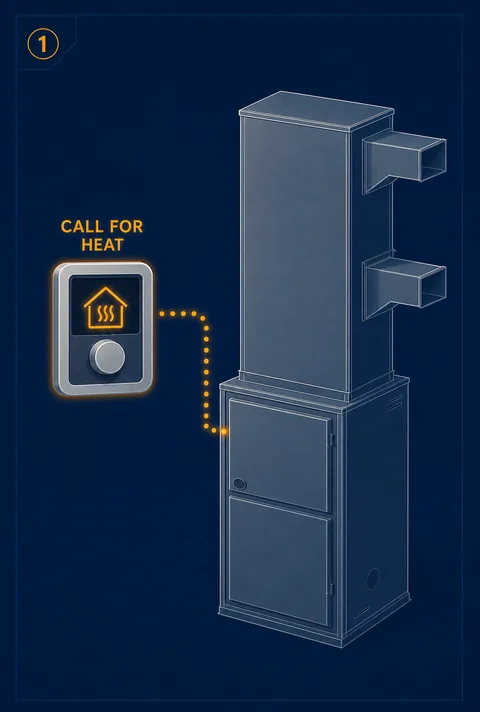
Note Heat mode, setpoint, room temperature, displayed messages, and whether the thermostat still indicates heating when the furnace stops.
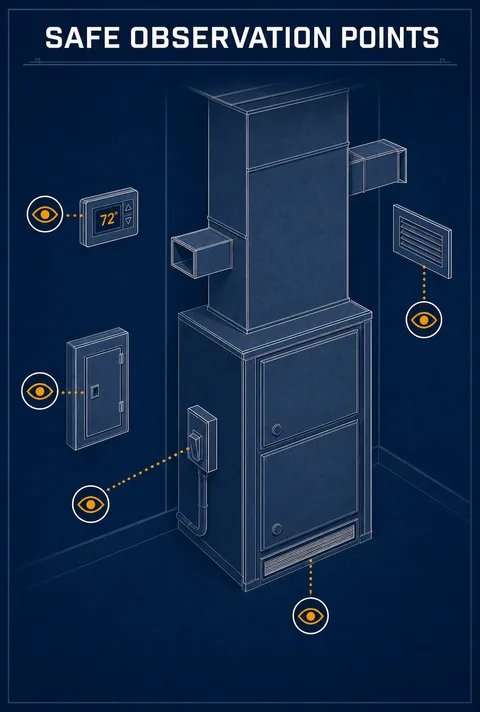
From the living space, note whether warm air begins, whether the blower continues after the heat stops, and whether the home gains temperature.
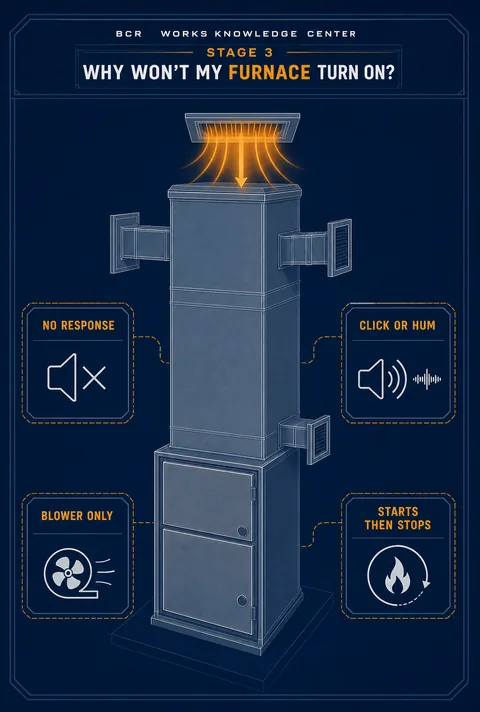
Record approximate run time, off time, how often the behavior repeats, and whether the furnace tries several times before stopping.
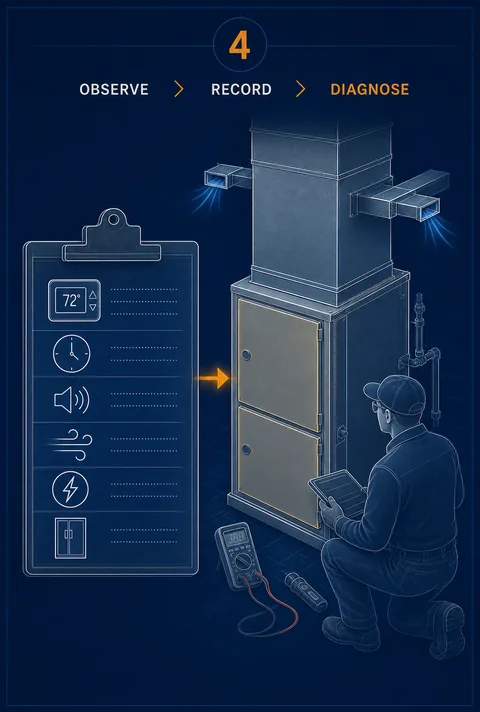
Mention a recent filter change, thermostat programming, outage, service visit, renovation, or electrical work that occurred before the symptom began.
The same visible cycle can result from different airflow, safety, ignition, venting, control, or sizing conditions.
What Does the Cycling Pattern Tell You?
| What You Notice | What It May Suggest | What Still Needs Verification |
|---|---|---|
| Burners stop after several minutes while the thermostat still calls for heat | An overheating or safety-limit response may be involved | Temperature rise, airflow, filter effect, blower operation, and the reason the safety responded. |
| Burners light briefly and then stop | The furnace may not be proving or maintaining the required operating condition | Ignition, flame verification, combustion, fuel, venting, and control sequence. |
| Several startup attempts occur without sustained heat | The startup sequence is being interrupted | The exact stage that fails and the condition preventing completion. |
| Frequent cycles still reach the thermostat setpoint | Thermostat location, control settings, building load, or equipment capacity may matter | Actual cycle times, temperature swing, equipment sizing, and building conditions. |
| Blower continues after the burners stop | Air movement and heat production are ending at different times | Whether this is normal post-cycle operation or a response to an interrupted heating cycle. |
What should I avoid?
Internal fuel, electrical, combustion, and moving components require qualified service.
Every safety must remain installed and operational.
Never use an oven, grill, or unsafe combustion source for space heating.
Repeated setpoint and mode changes can obscure the timing pattern a technician needs to evaluate.
Allow the observed on-and-off pattern to remain intact unless a safety condition requires leaving the area.
Outdoor temperature, system sizing, thermostat location, and actual run time must be considered together.
What Should I Note Before a Professional Visit?
Mode, setpoint, displayed room temperature, schedule, and exact messages.
How long the furnace runs, how long it stays off, and how often the pattern repeats.
Whether warm air begins, whether airflow continues after heat stops, and whether the home gains temperature.
Clicks, repeated attempts, unusual mechanical noise, gas odor, smoke, or electrical burning odor.
Filter replacement, thermostat changes, outage, maintenance, renovation, or electrical work.
Equipment location, parking, pets, locked areas, and authorization contact.
What Should I Remember?
A dirty filter, thermostat condition, or blocked airflow may be safe to identify from outside the equipment. If those checks do not explain the repeated starts and stops, the furnace needs professional diagnosis. Short cycling is a symptom shared by several different conditions—not proof that a particular part or the furnace itself should be replaced.
Related Resources
Tell us what you observed and when it happens.
BCR Works will use the operating pattern to guide diagnosis—not guess at a repair.