
Why Won’t My Furnace Turn On?
“Won’t turn on” can describe several different operating patterns. What happens after the thermostat calls for heat—silence, a click, airflow without heat, a brief start, or repeated attempts—provides more useful evidence than guessing which part failed.
Serving Harford County, Baltimore County, and Howard County.
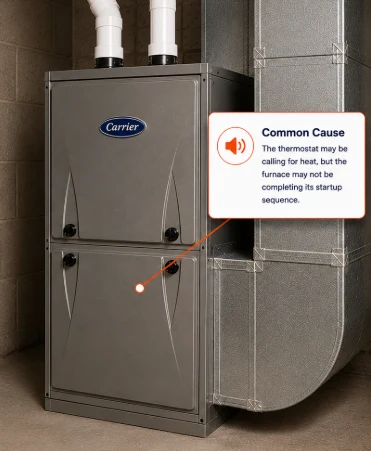
At a Glance
A furnace that appears not to turn on may be receiving no heat request, may be unable to begin its sequence, may begin and stop, or may run only part of the sequence. The safest and most useful next step is to observe what the thermostat and equipment do without opening the furnace or attempting a repair.
The system may be silent, make a sound, move air, start briefly, or retry.
Timing, sound, airflow, display behavior, and recurrence help define the pattern.
Do not open panels, bypass safeties, handle wiring, or repeatedly reset power.
How a Furnace Startup Sequence Should Work
A gas furnace does not move directly from thermostat adjustment to warm air. It follows an ordered control and safety sequence. The point where that sequence stops helps a professional decide what to test.
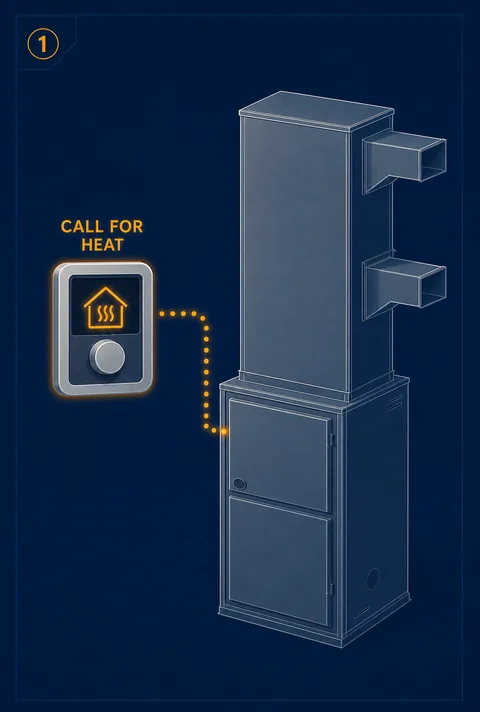
The thermostat compares the room temperature with the setpoint and sends a heat request.
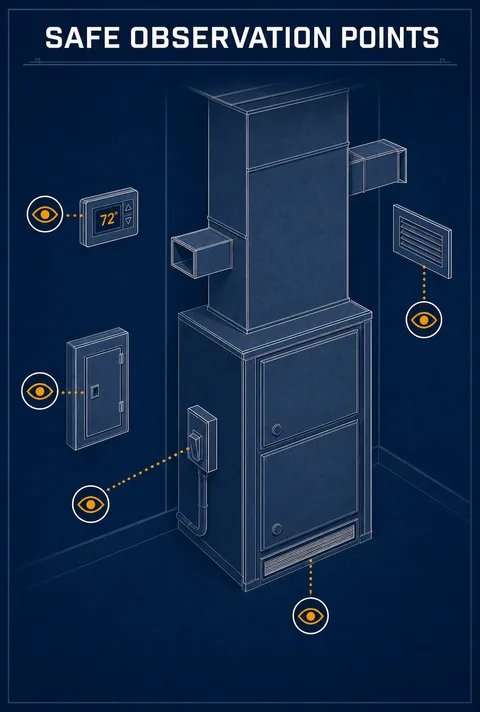
Power, access panels, controls, and safety conditions must permit the sequence to continue. Homeowners observe only from outside the equipment.
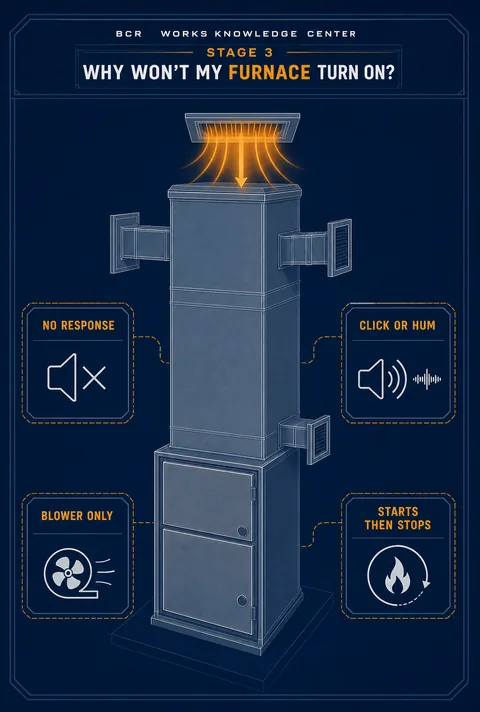
Silence, a click or hum, blower-only operation, or a brief start are different patterns—not diagnoses.
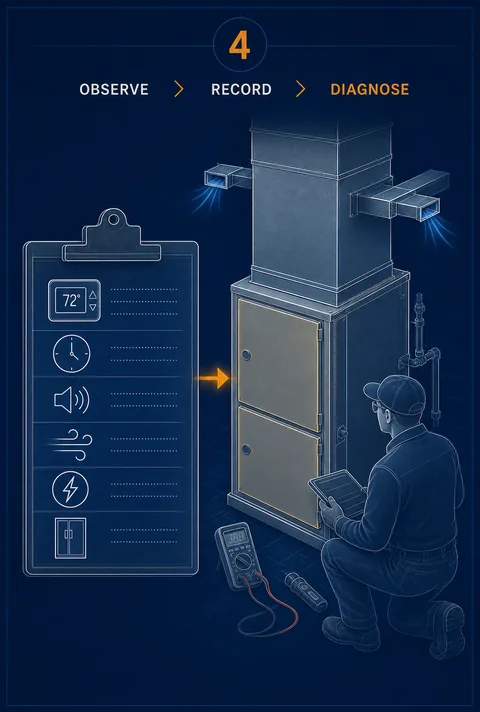
Accurate notes help a technician reproduce the condition and test the correct part of the sequence.
One observation cannot confirm a thermostat, igniter, control board, safety, motor, electrical problem, or any other repair.
Quick Answer
If a furnace will not turn on, confirm that the thermostat is in HEAT mode and set above room temperature, then observe the display and listen for the system’s first response. From outside the equipment, note whether the furnace is silent, clicks or hums, starts and stops, or runs the blower without producing heat.
You may visually check whether an accessible breaker appears tripped, whether an accessible furnace service switch appears off, whether the furnace panel looks fully seated, and whether an accessible filter is visibly overdue for replacement. Do not open panels, remove covers, handle wiring, touch internal components, bypass a switch, or repeatedly reset a breaker.
If the thermostat is calling for heat and the furnace does not establish normal operation, professional diagnosis is the appropriate next step. The observed pattern narrows the investigation but does not identify a repair by itself.
What can I safely observe?
These checks describe the condition without asking a homeowner or resident to become the technician.
Confirm HEAT is selected and the setpoint is above the displayed room temperature.
Note whether the screen is normal, blank, dim, showing an alert, or reporting a heat call.
Listen from a safe distance for silence, a click, hum, motor sound, airflow, or repeated attempts.
Notice whether any air reaches the supply vents and whether it is warm, room temperature, or cool.
From outside, note an accessible tripped breaker or an accessible service switch that appears off.
Without removing anything, note whether the furnace access panel looks fully seated.
If the filter can be viewed without opening furnace panels, note whether it appears heavily loaded.
Record the indoor temperature and whether it is holding steady or continuing to fall.
Note an outage, thermostat change, maintenance visit, filter change, electrical work, or other recent event.
Gas odor, smoke, arcing, or electrical burning changes the response from observation to immediate safety action.
What should I avoid?
Internal fuel, electrical, combustion, and moving components require qualified service.
Do not jump thermostat terminals, move wires, or probe electrical components.
A switch or safety that prevents operation must remain in place and be evaluated professionally.
A breaker that trips again indicates a condition that requires diagnosis.
Repeated cycling can change evidence and may continue an unsafe condition.
Common online answers do not confirm the cause in your system.
What does “my furnace won’t turn on” actually mean?
Homeowners use “won’t turn on” to describe several different conditions. The thermostat may not appear to request heat. The furnace may remain completely silent. It may click or hum without continuing. It may begin a sequence and stop. The blower may run while the home receives no heat. Or the furnace may operate intermittently and fail only under certain conditions.
Those distinctions matter because each one places the interruption at a different point in the operating sequence. Describe what the system actually does rather than selecting a part name. That gives a technician a better starting point.
What thermostat observations are useful?
Confirm HEAT mode, the displayed room temperature, the selected setpoint, and whether the thermostat indicates that it is calling for heat. If the display is blank, note that fact. If it shows a warning, low-battery message, schedule hold, or equipment alert, record the exact wording rather than clearing it.
After raising the setpoint once, observe what happens next. Does the thermostat acknowledge the request? Does the furnace respond immediately, after a delay, or not at all? Avoid repeatedly changing modes or temperatures because that can make the sequence harder to interpret.
What can I observe about power, the breaker, and the furnace switch?
A furnace needs electrical power even when it burns gas. From the outside, you may note whether an accessible circuit breaker appears tripped and whether an accessible furnace service switch appears off. These are observations, not an invitation to perform electrical work.
If a breaker has tripped, do not keep resetting it. If it trips again after one normal reset performed according to the home’s safe operating practices, leave it off and request service. Never remove an electrical-panel cover, touch conductors, replace a breaker, or improvise around a switch. The related guide Why Does My AC Keep Tripping the Breaker? explains why repeated resets are not a diagnosis.
Can a filter or airflow condition affect furnace startup?
An accessible, heavily loaded filter or blocked return can be useful context because airflow affects furnace operation. You may inspect a filter only if it is designed for routine homeowner access and can be viewed without opening furnace panels. Note the filter size, visible condition, and approximate replacement date.
A dirty filter does not automatically explain a no-start condition, and replacing it does not confirm that the system is safe or repaired. If the furnace still will not operate normally, the full sequence should be diagnosed. Regular HVAC maintenance can document filter, airflow, electrical, and operating conditions before they become an emergency.
What can I observe about a furnace safety switch?
Many furnaces are designed not to operate if an access panel is not fully seated. From the outside, you may notice that a panel looks loose, shifted, or recently removed. Do not remove the panel to find the switch, press it by hand, tape it down, or bypass it.
A closed-panel observation is useful because it may explain why the system changed after filter replacement or service. It does not prove that a door switch is the cause. Internal safeties, controls, and operating conditions must be evaluated by a qualified technician.
Which furnace response patterns help diagnosis?
| Observed Pattern | Why It Matters | What Still Requires Verification |
|---|---|---|
| No thermostat response and a blank display. | The heat request and thermostat power path need context. | Thermostat, power, controls, and system configuration. |
| Thermostat calls for heat, but the furnace is silent. | The sequence may not be beginning. | Power, controls, safeties, and the actual heat command. |
| A click or hum occurs, then nothing else. | The furnace may be attempting one stage without continuing. | Which component responded and why the sequence stopped. |
| The furnace starts, then stops quickly. | An interrupted sequence or safety response may be occurring. | The exact stopping point and operating condition. |
| The blower runs, but no heat is established. | Air movement and heat production are not the same stage. | Thermostat setting, sequence, controls, safeties, and furnace operation. |
| The furnace retries several times. | Recurrence and timing can help reproduce an intermittent condition. | The complete sequence during a failed attempt. |
| The furnace works sometimes but not always. | Weather, runtime, outages, recent work, and timing may be relevant. | Conditions present when the failure occurs. |
Sounds are evidence only when described accurately. “One click,” “steady hum,” “motor starts,” and “blower runs” are more useful than assuming an igniter, motor, board, or safety has failed.
What should change after I adjust the thermostat?
After one deliberate setpoint increase, the thermostat should register a heat demand and the furnace should begin its normal sequence after any built-in delay. Listen for the first response and note the approximate time until airflow begins. Then observe whether the air becomes warm and whether the indoor temperature begins moving toward the setpoint.
If nothing changes, or if the furnace begins and stops without establishing heat, avoid repeated adjustments. A stable, repeatable observation is more useful for HVAC diagnosis and second opinions than a long series of resets.
When does loss of heat become urgent?
Urgency depends on safety conditions, indoor temperature, outdoor weather, who occupies the home, and the risk of frozen plumbing. A gas odor, carbon-monoxide alarm, smoke, visible arcing, or electrical burning requires immediate safety action rather than ordinary scheduling.
Without those hazards, contact BCR Works promptly when the indoor temperature is falling, outdoor temperatures are near or below freezing, vulnerable occupants are present, pipes may freeze, or the furnace repeatedly starts and stops. Share the current indoor temperature, outdoor conditions, occupancy concerns, and whether another safe heat source is available. Do not use an oven, grill, or unvented combustion appliance as temporary heat.
How BCR Works Diagnoses a Furnace That Will Not Turn On
BCR Works begins with the thermostat request and verifies the operating sequence in order. Depending on the observed pattern, diagnosis may include power, thermostat communication, control response, safeties, venting and combustion sequence, ignition, blower operation, airflow, and the conditions present when the failure occurs.
The goal is to identify the actual interruption before recommending work. That repair-first approach avoids replacing a commonly blamed part without evidence. Learn more about Gas Furnace Services, Residential HVAC Services, and The Works maintenance program.
What should I note before a professional visit?
Mode, setpoint, room temperature, display messages, and whether it indicates a heat call.
Silence, click, hum, motor sound, airflow, or repeated attempts.
When the problem began and how long each attempt lasts.
Current indoor temperature and whether it is falling.
Outage, thermostat change, filter change, service, or electrical work.
Equipment location, parking, pets, locked areas, and the person authorized to approve work.
Photos of the thermostat display, furnace model/serial label if it is visible without opening anything, and the filter size may also help. Do not remove a panel to obtain a photo.
What should I remember?
Confirm a heat request, record the first response, note timing, sound, airflow, display behavior, and temperature trend, then stop. Do not open the furnace, bypass safeties, perform electrical work, or repeatedly reset the system. Careful observations help a professional diagnose the correct problem and support an honest repair-first recommendation.
Related Resources
Tell us what your furnace does after the thermostat calls for heat.
BCR Works will use the observed pattern to guide professional diagnosis—not guess at a repair.