
Why Does My Furnace Smell Like Burning?
A burning smell can range from brief dust odor at seasonal startup to an electrical, overheating, smoke, or combustion-related condition. Odor alone cannot confirm the cause, but some odor patterns require immediate shutdown and safety action.
Serving Harford County, Baltimore County, and Howard County.
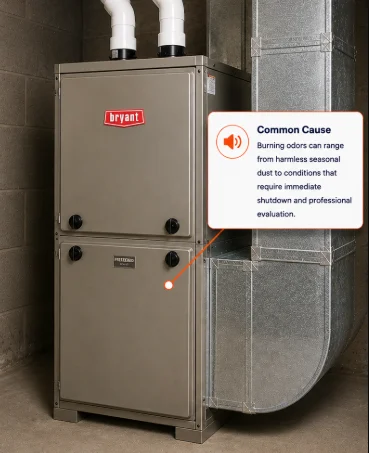
At a Glance
A burning smell can range from brief dust odor at seasonal startup to an electrical, overheating, smoke, or combustion-related condition. Odor alone cannot confirm the cause, but some odor patterns require immediate shutdown and safety action.
Timing and sequence are more useful than naming a suspected part.
Use thermostat, sound, airflow, odor, and temperature observations only.
Stable observations help professional diagnosis begin in the right place.
How to Observe the Operating Pattern
The same four-step method applies across the BCR Works Heating Field Guide: establish the thermostat request, observe safely, identify the response pattern, and record the professional handoff.
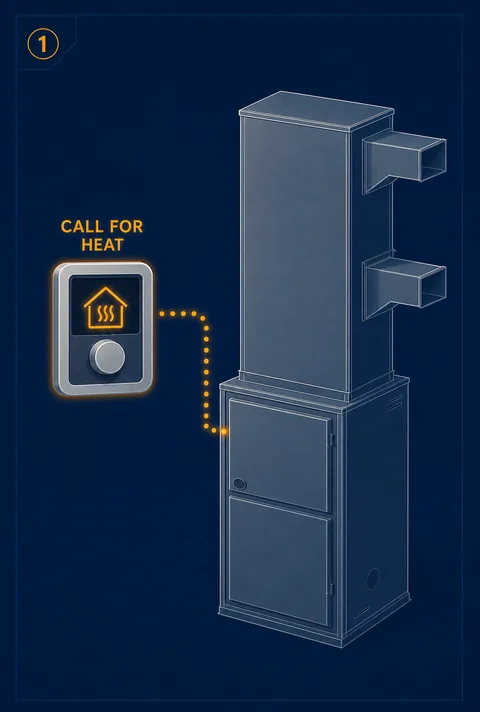
Record mode, setpoint, room temperature, display messages, and whether the thermostat indicates heating.
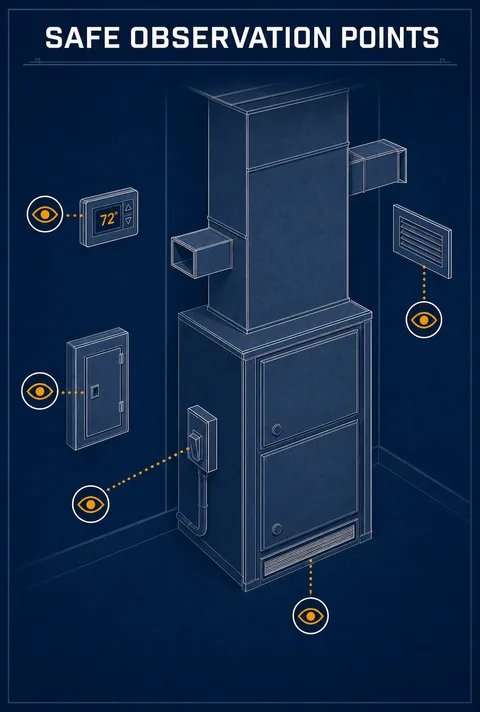
Note visible controls, accessible filter condition, sounds, airflow, odors, and temperature trend without opening panels.
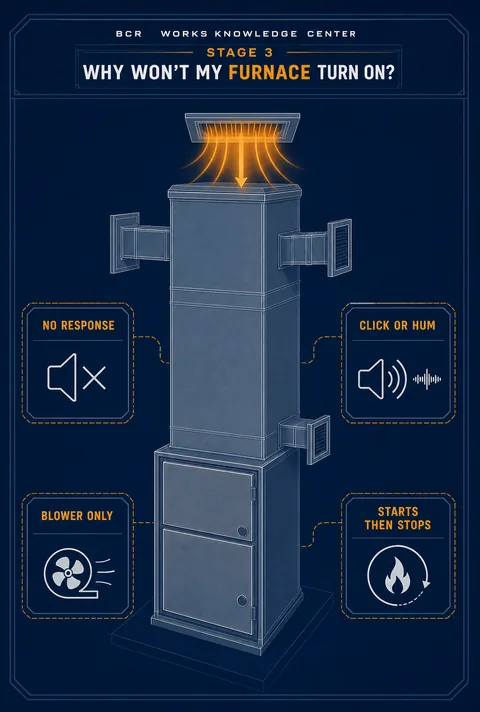
Record what begins, what stops, when it changes, and whether the condition repeats.
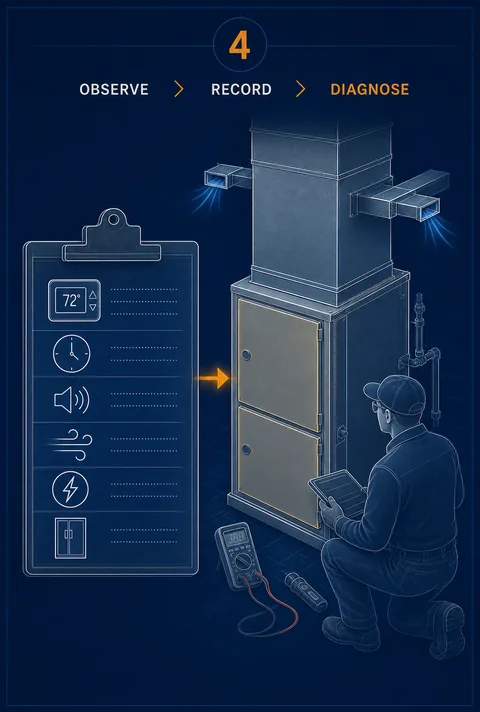
Share timing, settings, sounds, airflow, recent changes, and access information with the technician.
Diagnosis must verify the operating sequence and actual condition before work is recommended.
Quick Answer
A burning smell can range from brief dust odor at seasonal startup to an electrical, overheating, smoke, or combustion-related condition. Odor alone cannot confirm the cause, but some odor patterns require immediate shutdown and safety action.
Begin with one deliberate thermostat observation and then watch the complete response. Note the first sound, airflow, approximate runtime, indoor-temperature trend, and whether the condition repeats. Do not open panels, handle wiring, bypass safeties, or repeatedly reset power.
If heat is not established or maintained, the condition repeats, or safety is uncertain, schedule professional HVAC diagnosis.
What can I safely observe?
Mode, setpoint, room temperature, fan setting, schedule, and visible messages.
When the condition begins, how long it lasts, and how often it repeats.
Silence, click, hum, bang, scrape, rattle, blower sound, or repeated attempts.
Whether air moves, its relative temperature, and whether flow changes.
An accessible breaker, service switch, or thermostat alert viewed from outside only.
Size, visible loading, fit, and approximate replacement date without opening panels.
Whether the home is warming, holding, or continuing to get colder.
Outage, service, filter, thermostat, renovation, or electrical work.
What should I avoid?
Internal fuel, electrical, combustion, and moving components require qualified service.
Every safety must remain installed and operational.
Never use an oven, grill, or unsafe combustion source for space heating.
Turn the system off and request prompt service when an odor suggests overheated wiring or components.
Leave the area and seek appropriate emergency assistance instead of trying to locate the source.
A brief first-cycle dust smell differs from a persistent, worsening, electrical, plastic, or fuel-related odor.
Can a dusty smell be normal at the beginning of heating season?
A mild dusty odor may occur briefly when a system first heats after a long idle period. It should diminish quickly. A strong odor, persistent recurrence, smoke, visible damage, abnormal sound, or failure to heat normally should not be dismissed as seasonal dust.
Describe the condition in terms of timing, thermostat state, airflow, sound, odor, temperature change, and recurrence. Those observations narrow the diagnostic direction without confirming a part or repair.
What does an electrical or melting smell change?
A sharp electrical, hot wiring, melting plastic, or fish-like odor deserves prompt attention. Stop the furnace if it is safe to do so and request service. Do not remove covers, touch wiring, reset a repeatedly tripped breaker, or search for a hot component.
Describe the condition in terms of timing, thermostat state, airflow, sound, odor, temperature change, and recurrence. Those observations narrow the diagnostic direction without confirming a part or repair.
What should I do if I smell gas?
Do not operate switches, create sparks, or remain inside to investigate. Leave the building and contact the gas utility or emergency services from a safe location. This is not an ordinary HVAC scheduling situation.
Describe the condition in terms of timing, thermostat state, airflow, sound, odor, temperature change, and recurrence. Those observations narrow the diagnostic direction without confirming a part or repair.
Why does odor location and timing matter?
Note whether the odor appears at the furnace, one supply vent, many vents, only at startup, throughout the cycle, or after shutdown. Describe recent filter changes, maintenance, painting, cleaning products, or nearby electrical work without assuming the furnace caused every odor.
Describe the condition in terms of timing, thermostat state, airflow, sound, odor, temperature change, and recurrence. Those observations narrow the diagnostic direction without confirming a part or repair.
Which patterns help professional diagnosis?
| Observed Pattern | Why It Matters | What Still Requires Verification |
|---|---|---|
| Light dusty odor at the first seasonal startup | Dust on warm surfaces may be involved | The odor should be brief, mild, and unaccompanied by smoke or abnormal operation. |
| Sharp electrical or melting-plastic odor | An overheating electrical condition may be present | Stop operation and request prompt qualified evaluation. |
| Visible smoke or arcing | Immediate fire and electrical risk | Leave the area and seek appropriate emergency assistance. |
| Gas odor | Possible fuel-gas emergency | Leave the area and contact the gas utility or emergency services from a safe location. |
| Odor returns every cycle | The condition is repeatable, not a one-time transition | Timing, location, filter condition, and equipment operation require diagnosis. |
How BCR Works Diagnoses This Condition
BCR Works begins with the thermostat request and evaluates the system in operating order. Testing follows the evidence: power, controls, safeties, sequence timing, combustion when applicable, blower operation, airflow, temperature change, and the conditions present when the symptom occurs.
The goal is to identify the actual condition before recommending work. Learn more about Gas Furnace Services, Residential HVAC Services, HVAC Maintenance, and The Works.
What should I note before a professional visit?
Mode, setpoint, room temperature, and exact messages.
What starts, what stops, and the order in which it happens.
Approximate runtime, off-time, recurrence, and time of day.
Indoor temperature trend and which areas are affected.
Outage, maintenance, filter, thermostat, or electrical work.
Equipment location, parking, pets, locked areas, and authorization contact.
What should I remember?
A burning smell can range from brief dust odor at seasonal startup to an electrical, overheating, smoke, or combustion-related condition. Odor alone cannot confirm the cause, but some odor patterns require immediate shutdown and safety action. Record the sequence safely, stop when the condition may be unsafe, and let verified testing determine the recommendation.
Related Resources
Tell us what you observed and when it happens.
BCR Works will use the operating pattern to guide diagnosis—not guess at a repair.