
Cracked Heat Exchanger Diagnosis: Second Opinion & Safety Guide
Expert HVAC Solutions Across Harford, Baltimore, and Howard Counties
A homeowner-first guide for Central Maryland families who were just told their gas furnace has a cracked or failed heat exchanger and now need the safety claim verified with real evidence.
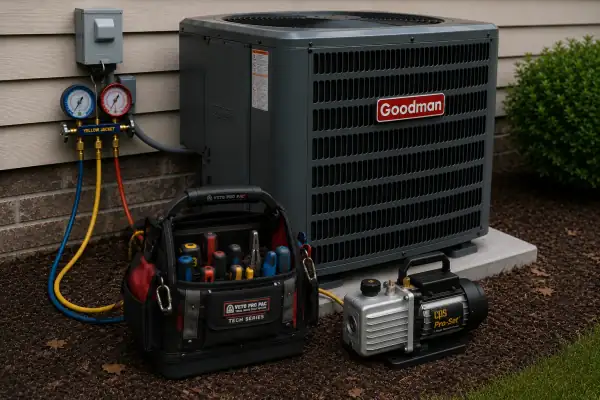
Combustion analyzer readings, carbon monoxide testing, and direct visual inspection before replacement decisions.
🛑 Told Your Furnace Has a Cracked Heat Exchanger?
A compromised heat exchanger can become a real carbon monoxide safety issue, so the claim must be treated seriously. It also happens to be one of the most abused high-ticket sales diagnoses in residential HVAC. Before you approve a rushed furnace replacement, make sure the failure is proven with combustion analyzer data, documented carbon monoxide evidence, or direct visual inspection findings.
The Most Critical Safety Component Inside Your Heating System
The heat exchanger is the structural steel barrier separating your home’s indoor breathing air from raw combustion exhaust. Furnace burners fire inside sealed metal cells, while the indoor blower moves household air across the outside of those hot cells. If the metal cracks, rusts through, or separates at a seam, combustion gases may be able to enter the supply air path.
That is why a confirmed heat exchanger breach can legally condemn equipment. But because this diagnosis often decides whether a homeowner spends hundreds or thousands, it should never be delivered as vague fear language. BCR Works verifies the claim with direct physical evidence.
💬 The Plain-English Translation: What Does It Do?
The Analogy: Think of your heat exchanger like a high-grade automotive exhaust manifold wrapped inside a sealed air chamber. The toxic fumes must stay inside the metal channels and leave through the flue. Your indoor air should only touch the outside of those channels, absorb heat, and move safely through the duct system.
🔍 Symptoms Homeowners Usually Notice
- The flame dance: When the indoor blower starts, burner flames visibly distort, flutter, or push backward because blower pressure is interfering with the combustion stream.
- Recurrent short cycling: The furnace overheats and opens high-temperature limits before the thermostat is satisfied.
- Carbon monoxide alarm events: Safety alarms trigger during longer heating runs, especially during heavy winter demand.
- The sudden replacement pitch: A technician claims an invisible crack exists but cannot show hard combustion data or explain exactly where and how the failure was found.
How a Professional BCR Works Technician Verifies the Failure:
We never guess on carbon monoxide safety. Our technicians directly inspect accessible heat exchanger cells for visible fractures, rust breaches, separations, or popped eyelets. We pair this visual inspection with calibrated combustion analysis and carbon monoxide testing in the cabinet, supply air, and surrounding space to confirm the finding with measured data, not just a visual impression.
⚠️ How We Verify This: The Invisible “Micro-Crack” Scare
Because a cracked heat exchanger can justify shutting down a furnace, commission-driven sales companies sometimes use it as a hammer. The scare script sounds like this: “I see a micro-crack, your furnace is a ticking time bomb, and you need to sign for a new system right now.”
Don’t wait on a risk like this — get it verified.
🔧 Our Structural Safety Audit Protocol
- Visual cell inspection: We inspect the heat exchanger path for cracks, rust-through, popped eyelets, separation, and distortion.
- Flame behavior review: We watch burner behavior before and after blower startup for signs of pressure disturbance.
- Temperature rise cross-check: We compare actual temperature rise against the furnace rating to identify overheating and airflow stress.
- CO and combustion verification: We test for carbon monoxide evidence where appropriate and document readings clearly.
⚖️ Repair vs. Replace: The Honest Version
A confirmed cracked heat exchanger is not a patch job. It cannot be welded, glued, or sealed in the field. If the furnace is newer and under a valid parts warranty, an OEM heat exchanger assembly may be practical. If the system is older than 15 years, has airflow damage, or needs major teardown labor, full furnace replacement is often the cleaner financial and safety decision. The key is that the evidence comes first.
⏱️ Logistics & Expectations
- Availability: Heat exchangers are furnace-specific OEM assemblies. Warranty status, model number, and equipment age matter.
- Labor Intensity: Replacement is intensive. It often requires a full furnace cabinet teardown and can take 4 to 6 hours.
- Safety Verification: After any heat exchanger replacement, airflow, temperature rise, burner operation, venting, and combustion safety must be verified.
What Does This Repair Typically Cost?
Typical price range for this repair: $1,200–$3,000, depending on your specific system and part accessibility. The exact number is confirmed during your diagnostic visit — we test the specific failure point before quoting, rather than guessing.
❓ Frequently Asked Questions (Heat Exchanger Safety)
Q: Can a cracked heat exchanger cell be welded or patched safely?
A: No. Professional HVAC safety standards do not support field welding, patching, or gluing a failed heat exchanger cell. Heat expansion cycles can reopen the risk. The component must be replaced, or the furnace must be upgraded.
Q: What causes a heavy steel heat exchanger to crack prematurely?
A: Restricted airflow is a primary cause. Severe filter blockage, dirty blower wheels, blocked return air, closed registers, or duct restrictions trap heat in the furnace cabinet and stress the metal beyond its design limit.
Q: Should I replace the furnace immediately if another company says the heat exchanger is cracked?
A: If the failure is proven, the furnace should not continue operating unsafely. But before approving a major replacement, ask for the evidence. BCR Works can verify the diagnosis with combustion analyzer readings, carbon monoxide testing, and a clear written explanation of the findings.