
Residential HVAC Diagnostics
Frozen Evaporator Coil: Root Causes & Proper Technical Resolution
A frozen indoor coil usually points to airflow trouble, refrigerant problems, or both. BCR Works verifies the root cause before adding refrigerant or recommending expensive parts.
Not sure if this is your exact issue? Go back to the main Central Maryland Air Conditioning Service Hub to review your other symptoms and quotes.
What Actually Causes a Frozen Evaporator Coil?
Restricted airflow
Restricted airflow is the most common reason an evaporator coil freezes, and it is often the least expensive problem to correct. A dirty filter, blocked return, closed supply vents, dirty blower wheel, or weak airflow path can keep enough warm indoor air from moving across the coil, allowing the coil surface to drop below freezing.
Low refrigerant charge from a slow leak
A low refrigerant charge can lower system pressure enough that the evaporator coil operates below the freezing point. If refrigerant is low, the correct next step is not just adding more refrigerant; the system needs to be evaluated for a leak so the same freeze-up does not keep returning.
Dirty or damaged evaporator coil
The coil itself can also become the restriction. Dust, pet hair, biological buildup, or damaged fins can block air from passing evenly across the coil surface, creating cold spots where ice starts forming even when the filter looks clean.
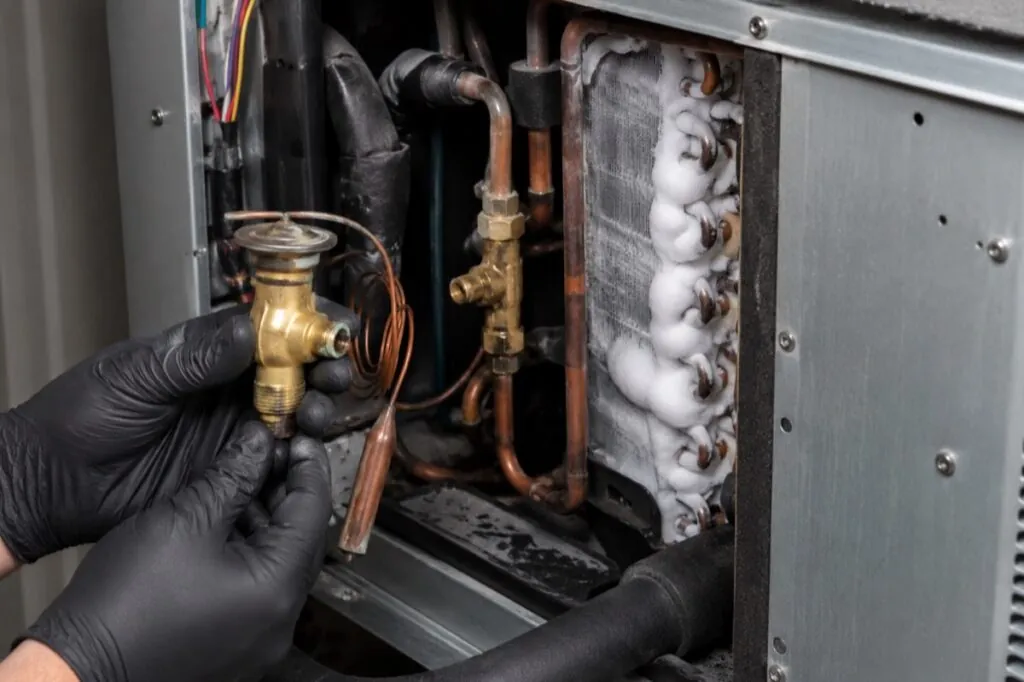
Restricted or failed TXV
A restricted or failed thermostatic expansion valve is less common than airflow trouble, but it can freeze the coil by starving the evaporator of the correct refrigerant flow. This type of failure has a distinct pressure and temperature signature, especially in the relationship between superheat and subcooling, so it should be confirmed with testing instead of assumed.
The rest of this guide focuses on TXV-specific diagnosis, since that’s a less commonly understood cause and one homeowners are more likely to get an inflated or incorrect quote for. If your filter is dirty or your system feels low on refrigerant, those are usually simpler, less expensive fixes — ask your technician to rule those out first.
🛑 If the Cause Is a Faulty TXV
When a technician diagnoses a failed Thermostatic Expansion Valve, or TXV, it means the mechanical component regulating cooling flow inside your indoor coil has stopped responding. Because a TXV restriction blocks the vital flow of refrigerant, it quickly causes your air conditioner to mimic other catastrophic failures.
Understanding how this valve operates can save you from paying for endless recurring refrigerant top-offs or aggressive high-pressure system replacements.
The BCR Works Second Opinion Rescue Line
Don’t let a technician guess at your system pressures or overcharge a restricted valve. Request a professional diagnosis from BCR Works so the restriction, airflow, superheat, and subcooling evidence can be evaluated before you approve a major repair. Request Diagnosis.
The Plain-English Translation: What Does It Do?
The Analogy: Think of the TXV as the highly automated, precision traffic controller of your entire cooling cycle. Mounted directly next to your indoor evaporator coil, this valve micro-manages the exact amount of liquid refrigerant entering the system.
It uses a small copper sensing bulb to constantly read line temperatures. If your home is hot, it opens to allow more cooling capacity; as the house drops to your target temperature, it throttles back. It acts like a precision adjustable spray nozzle, changing high-pressure liquid into a fine, low-temperature mist.
Symptoms & Real-World Diagnosis
When a TXV gets stuck shut or fails mechanically, it restricts the system and produces these key observations:
Rapid Indoor Coil Freezing
Because refrigerant is heavily restricted as it passes through the tiny valve opening, its pressure drops below freezing and turns your indoor coil into a block of ice.
Short Cycling on Low Pressure
The outdoor unit turns on, runs for two minutes, and shuts down abruptly because safety controls detect that the compressor is starving for returning gas.
Lukewarm Airflow
The indoor fan runs continuously, but the air from the vents is room temperature because the cooling loop is blocked from circulating.
How BCR Works Verifies TXV Failure
We use advanced digital manifold probes to run a complete thermodynamic calculation. A failed TXV exhibits very high superheat readings, meaning refrigerant gas returning to the compressor is starved of liquid, alongside normal or high subcooling, meaning refrigerant is backing up in the outdoor coil.
The data fingerprint: This superheat/subcooling combination proves the valve is physically restricted before we ever touch a wrench. Guessing from gauge pressure alone is not enough.
How We Verify This: The Low Freon Trap
A restricted or stuck-shut TXV exhibits operating pressure symptoms that look identical to an air conditioner running completely low on refrigerant charge. If an amateur or commission-driven technician connects gauges and immediately assumes the system is low on gas, they may pump fresh refrigerant into the loop.
The Reality Check: Because the valve is physically restricted, extra gas backs up inside the outdoor condenser, dangerously overcharging the system and risking permanent compressor destruction. Always demand that superheat and subcooling are verified using digital manifold probes before any refrigerant is added.
Don’t wait on a risk like this — get it verified.
The While-We-Are-In-There Checklist
When BCR Works unbolts or un-brazes a failed TXV, we follow rigid system protocols to protect your system:
Logistics & Expectations
Availability
Sized explicitly by system tonnage and factory cabinet design, usually requiring sourcing from local regional wholesale pools.
Labor Intensity
High. This requires capturing existing refrigerant, mechanical or torch surgery inside the indoor cabinet, and a precise factory charge weigh-in. Expect a 3 to 4-hour on-site operation.
What Does This Repair Typically Cost?
Typical price range for this repair: $2,000–$3,000, depending on your specific system and part accessibility. The exact number is confirmed during your diagnostic visit — we test the specific failure point before quoting, rather than guessing.
Frequently Asked Questions
What’s the most common reason an AC coil freezes?
The most common cause by far is restricted airflow — usually a dirty filter, closed vents, or a blocked return. When airflow drops, the coil gets too cold and ice forms on the surface. Before assuming anything more expensive is wrong, check your filter and make sure vents and returns are clear. If the coil keeps freezing with a clean filter and open airflow, that points toward a refrigerant-side problem, including a possible TXV restriction.
Can a stuck TXV valve be cleaned or cleared without replacement?
In rare instances, a valve gets temporarily stuck due to oil sludge or additive buildup and can occasionally be broken free. However, if the internal mechanical diaphragm or copper capillary tube loses its factory gas charge, the valve cannot be saved and must be mechanically replaced.
Why do TXVs fail prematurely?
The primary cause of TXV failure is system contamination. If a system was installed without a proper nitrogen purge during welding, tiny copper oxidation flakes can break loose, drift through the system, and lodge inside the TXV’s micro-fine internal needle assembly.