
Residential Air Conditioning Services
Capacitor & Contactor Diagnosis: The Most Common Electrical AC Failures
Many no-cool calls start with a failed capacitor, contactor, or electrical connection. BCR Works verifies the simple electrical causes first before discussing larger repairs.
Not sure if this is your exact issue? Go back to the main Central Maryland Air Conditioning Service Hub to review your other symptoms and quotes.
🛑 Is an Inexpensive Electrical Fault Mimicking a Blown Motor?
If your central air conditioning system suddenly drops dead on a scorching afternoon, the culprit is statistically an electrical failure rather than a catastrophic mechanical breakdown. The dual run capacitor and the high-voltage contactor are the primary working muscles inside your outdoor unit’s control cabinet.
An isolated capacitor or contactor failure is not an automatic reason to replace equipment. Use the Repair or Replace Calculator when a larger recommendation follows a relatively small electrical diagnosis.
Because these parts bear the brunt of extreme electrical arcs and heat cycles, they are engineered to fail first to protect your expensive compressor engine. Before you let an aggressive technician sell you a completely new air conditioner, ensure they show you the exact electrical numbers behind these critical switches.
The BCR Works Second Opinion Rescue Line
Think your recent electrical repair quote is out of line or misdiagnosed? Request a professional diagnosis from BCR Works before approving the repair, so the electrical failure path is verified with meter-proven testing. Request Diagnosis.
The Plain-English Translation: What Do They Do?
The Analogy: Think of your dual run capacitor as a powerful, heavy-duty electrical storage tank designed solely to give your outdoor motors an immediate kickstart. Your home’s standard electrical current does not possess the instant torque required to spin a heavy AC compressor and a large fan blade up to speed from a dead stop.
The capacitor stores high-voltage energy and unleashes it in a concentrated burst to fire the motors into action. The contactor is the physical gateway switch: when your indoor thermostat calls for cooling, it sends a low-voltage signal that magnetically pulls the silver contacts down, allowing raw 240-volt power to flood into your system.
Symptoms & Real-World Diagnosis
When these high-voltage electrical controls break down, your system will usually flash these specific warning signs:
The Outdoor Hum
The indoor fan blows room-temperature air, but the outdoor unit sits completely still while emitting a loud electrical humming or buzzing noise every few minutes.
Repetitive Clicking
You hear a sharp physical click from the outdoor electrical panel as the thermostat attempts to start the cooling cycle, but neither the top fan nor the compressor responds.
The Hard Start
The outdoor fan spins perfectly, but the compressor struggles to turn over, shaking the outdoor cabinet or occasionally tripping your home’s main electrical circuit breaker.
How BCR Works Verifies Electrical Failure
We prove our electrical diagnoses with hard numerical data. Our technicians disconnect power and test the capacitor utilizing a digital multimeter set to capacitance mode to read its exact microfarads, or uF.
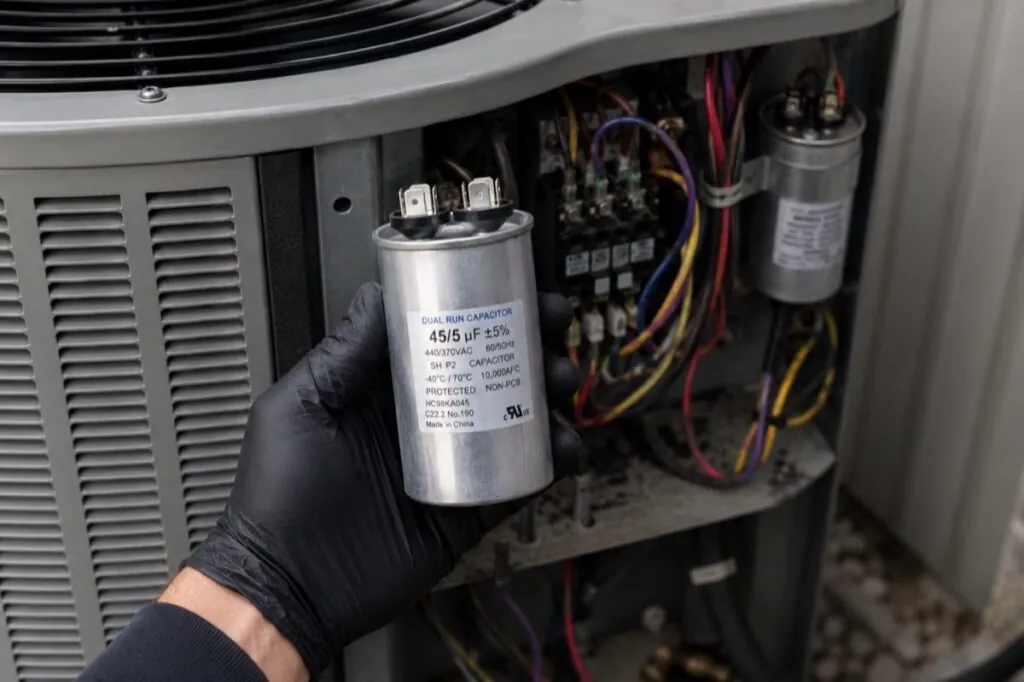
The meter test: If a capacitor rated for 45/5 uF reads significantly below its 5% tolerance threshold, it is electrically dead. For contactors, we visually inspect the points for heavy pitting, electrical carbon burns, or ants wedged in the contacts, and test for voltage drop across the terminal lugs.
How We Verify This: The Dead Compressor Scam
Because a failed capacitor stops a compressor instantly while causing it to hum loudly, commission-driven sales technicians love to look a homeowner in the eye and say, “Your compressor is completely locked up; you need an entirely new system.”
The Reality Check: Always demand that the technician show you the physical capacitor. A failed capacitor will frequently bulge at the top, leak oil, or register near zero on a digital meter. Swapping a dead capacitor or an unseated contactor is a routine repair that takes under an hour. Never allow a company to condemn your whole system without showing you failed electrical metrics first.
Don’t wait on a risk like this — get it verified.
The While-We-Are-In-There Checklist
When BCR Works replaces your starting components, we ensure total operational safety with these steps:
Logistics & Expectations
Availability
Immediate. BCR Works trucks carry an inventory of universal and OEM-spec dual run capacitors and heavy-duty single/double pole contactors.
Labor Intensity
Low. This is a standard external electrical swap that requires zero invasion into your sealed refrigerant loop. Diagnostics and repair can often be wrapped up in less than 60 minutes on-site.
What Does This Repair Typically Cost?
Typical price range for this repair: $250–$400, depending on your specific system and part accessibility. The exact number is confirmed during your diagnostic visit — we test the specific failure point before quoting, rather than guessing.
Frequently Asked Questions
Why do capacitors fail so consistently during Maryland heatwaves?
Extreme summer heat is the ultimate killer of electrical components. High ambient temperatures combined with long, uninterrupted cooling runtimes cause internal oil pressure to expand inside the sealed aluminum casing, eventually popping the internal pressure relief switch and killing the component.
Should I change my capacitor proactively before it dies?
Yes. During our seasonal technical maintenance tune-ups, if we notice a capacitor’s microfarad reading has dropped by more than 10% of its factory rating, we recommend replacing it immediately. Catching a weak capacitor early prevents it from overheating compressor motor windings.