
Furnace Control Board & Safety Limit Lockouts: Second Opinion Guide
Expert HVAC Solutions Across Harford, Baltimore, and Howard Counties
A homeowner-first second-opinion guide for Central Maryland families who were told a furnace control board failed when the real cause may be a tripped safety limit, airflow restriction, rollout condition, or blower problem.
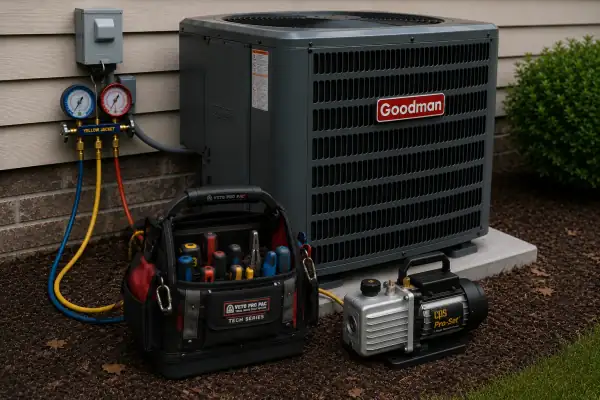
Continuity, voltage output, airflow, limit, and rollout checks before the board is condemned.
🛑 Told Your Furnace Needs an Expensive Control Board?
The control board is the furnace brain, so it is easy for a technician to blame it when the furnace locks out or flashes an LED code. But many “bad board” diagnoses are actually safety lockouts. The board may be doing exactly what it is designed to do: stopping the furnace because airflow, temperature, flame rollout, or another safety condition is out of range.
💬 The Plain-English Translation: What Does the Board Control?
The furnace control board coordinates the sequence of operation. It tells the inducer motor when to run, the igniter when to glow, the gas valve when to open, and the blower when to move warm air. It also watches safety switches. If a high-limit switch or rollout switch opens, the board shuts down operation to protect the home.
🔍 Symptoms Homeowners Usually Notice
When the control board or safety chain is involved, homeowners often see one of these patterns:
- Blinking red LED code: The furnace cabinet shows a diagnostic flash pattern, often pointing toward limit, rollout, pressure, ignition, or lockout status.
- Repeated overheating shutdowns: The furnace runs, then cuts out before satisfying the thermostat because internal temperatures climb too high.
- No output to a component: The board receives power but fails to send power to the blower, inducer, igniter, or gas valve when it should.
- The board gets blamed first: A contractor quotes a control board without proving the safety switches, airflow, and voltage outputs.
How a Professional BCR Works Technician Verifies the Failure:
BCR Works separates a true board failure from a safety lockout. We verify incoming power, transformer output, low-voltage calls, board output to each major component, and continuity across the safety chain. We also inspect airflow restrictions, filter condition, blower performance, high-limit behavior, rollout switch status, and visible board damage before recommending replacement.
⚠️ How We Verify This: A Lockout Is Not Always a Bad Board
A furnace that stops on a safety limit is not necessarily broken in the way the quote says. Sometimes the control board is correctly refusing to run because the system is overheating, starving for air, or seeing unsafe burner behavior.
Don’t wait on a risk like this — get it verified.
🔧 The “Before We Condemn the Board” Checklist
BCR Works audits the control circuit and safety path before recommending a board replacement:
- Incoming power confirmation: We verify proper line voltage, transformer output, thermostat call, and board power.
- Safety-chain continuity: We test high-limit switches, rollout switches, and related safeties instead of assuming the board failed.
- Airflow investigation: We inspect filter condition, return path, supply registers, blower operation, and overheating patterns.
- Output testing: We confirm whether the board is failing to energize the correct component when conditions are safe and the call is present.
⚖️ The Big Dilemma: Repair vs. Replace?
A control board can be a legitimate repair, but it should not be the first guess. If the furnace is otherwise safe and the board failure is proven, replacement may be reasonable. If the board failed because of water damage, repeated overheating, blower problems, or an aging furnace with several safety issues, the broader repair-versus-replace math should be reviewed carefully.
⏱️ Logistics & Expectations
- Availability: Control boards must match the furnace model, wiring layout, ignition sequence, blower type, and safety circuit design.
- Labor Intensity: Most board replacements are moderate-intensity electrical repairs requiring careful wire mapping and sequence testing.
- Safety Verification: After repair, the furnace should complete a full heat cycle with limit operation, blower timing, ignition, flame sensing, and shutdown behavior verified.
What Does This Repair Typically Cost?
Typical price range for this repair: $700–$1,200, depending on your specific system and part accessibility. The exact number is confirmed during your diagnostic visit — we test the specific failure point before quoting, rather than guessing.
❓ Frequently Asked Questions
Q: Does an LED code prove the control board is bad?
A: No. LED codes usually tell you where the furnace stopped, not always which part failed. The related circuit and safety conditions still need to be tested.
Q: Can a clogged filter make someone think the board failed?
A: Yes. A clogged filter can overheat the furnace and trip the high-limit switch. The board may lock out because it is protecting the equipment.
Q: What proves a control board is actually bad?
A: Correct incoming power combined with missing or incorrect output, failed relays, visible burn damage, or failed board logic after safeties and wiring are verified can prove board failure.