
Residential Air Conditioning Services
Refrigerant Leak Repair: Professional Pressure Testing & Verification
Low refrigerant is a symptom, not a final diagnosis. BCR Works verifies leak indicators, pressure behavior, and system condition before recommending repair, recharge, or replacement.
Not sure if this is your exact issue? Go back to the main Central Maryland Air Conditioning Service Hub to review your other symptoms and quotes.
The Core Rule of Your Closed Cooling Circuit
Your home’s central air conditioner is a permanently closed, sealed mechanical system. It does not consume, burn through, or use up refrigerant gas like oil or gasoline in a car engine.
The exact same chemical charge is engineered to cycle between your indoor and outdoor coils for decades without dropping an ounce. If an HVAC technician connects gauges and says your system is low on refrigerant, that means there is a physical hole or pinhole leak inside the copper line set, aluminum coil, service valve, or joint allowing gas to escape.
The BCR Works Second Opinion Rescue Line
Stop paying for temporary, recurring refrigerant top-offs. Request a professional diagnosis from BCR Works so refrigerant performance, leak evidence, and repair options can be reviewed before another charge is added. Request Diagnosis.
The Plain-English Translation: What Is Happening?
The Analogy: Think of your air conditioner’s refrigerant lines like a sealed car tire. If the tire is low on air, a nail, valve stem, or cracked sidewall is actively letting air escape.
Simply adding more air without fixing the hole means the tire will go flat again. In an AC system, refrigerant acts as the thermodynamic sponge that absorbs heat indoors and releases it outdoors; when the charge drops too low, the system loses its ability to absorb heat and your vents blow lukewarm air.
Symptoms & Real-World Diagnosis
Low refrigerant capacity inside a Central Maryland residential cooling system usually presents these clear symptoms:
Constant, Lukewarm Vent Air
The indoor blower runs and air moves strongly through your registers, but the air is barely cool and the thermostat will not pull down during a hot afternoon.
The Ice Block Setup
Low internal pressure drops the indoor evaporator coil below freezing, turning condensation into a solid block of ice around the coil.
Short Cycling on Safety Controls
The outdoor unit starts, runs briefly, and cuts off as a low-pressure safety switch interrupts power to protect the compressor from running dry.
How BCR Works Verifies Low Charge & Leak Failure
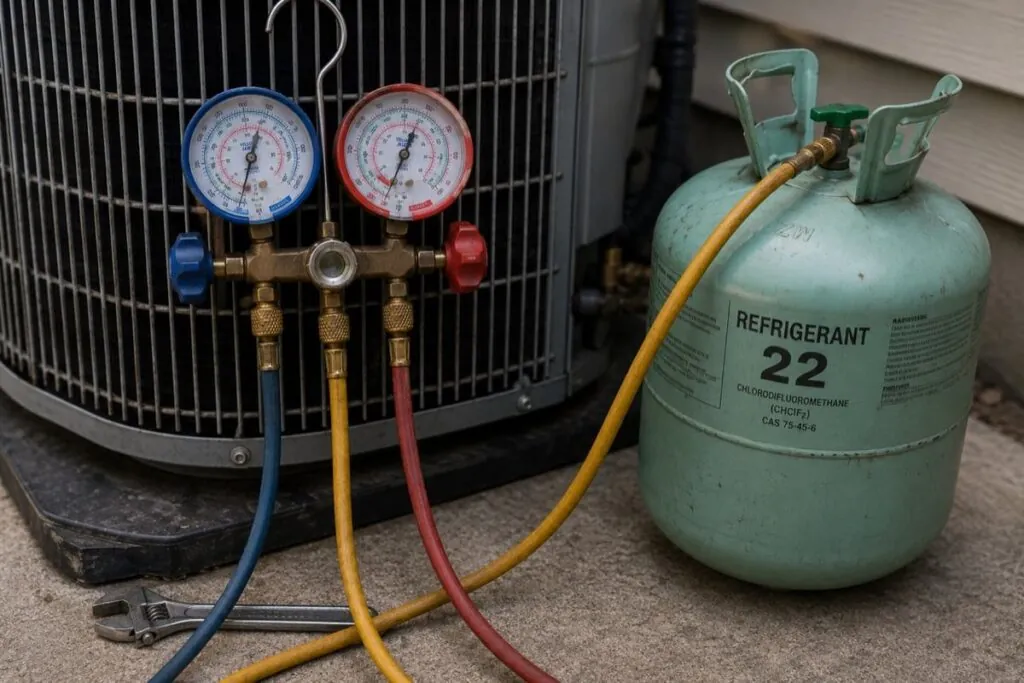
We prove leak diagnoses with hard numerical calculations. Our technicians connect digital manifold probes to read system subcooling, the indicator of liquid charge levels in the outdoor coil, and superheat, the indicator of indoor coil saturation.
Meter-Proven Diagnostic Rule: If subcooling is near zero and superheat is extremely high, we verify low charge before deploying electronic leak detectors to trace the exact location of the physical opening. Gauge pressure alone is not a complete diagnosis.
How We Verify This: The Gassing-Up Annual Routine
Never allow a technician to simply top off or inject fresh refrigerant into your system year after year without locating and discussing the source of the leak. Adding expensive gas to a leaking system without performing true leak isolation is a short-term band-aid that wastes money and releases refrigerant back into the atmosphere.
The Reality Check: We look for active oil tracking on coils and joints, use electronic sniffers to pinpoint leaks, and give you the technical facts needed to choose between a targeted repair and a practical system replacement. Always demand a written report showing where the leak was verified.
Don’t wait on a risk like this — get it verified.
Closed-Loop System Standards
When BCR Works conducts a certified leak evaluation or system recharge, we follow strict closed-loop refrigeration standards rather than guessing from a pressure chart.
If the leak repair is substantial or the equipment has other concerns, the Interactive HVAC Assessment can help organize the repair-versus-replacement evidence before you decide.
Logistics & Expectations
Availability
Immediate for standard R-410A refrigerant evaluations and precision recharges. Older R-22 systems require extra economic review because refrigerant supply is obsolete and expensive.
Labor Intensity
Medium to high. Leak detection with electronic sniffers often takes 1 to 2 hours; selected repairs may require recovery, brazing, pressure testing, vacuum evacuation, and a weight-based factory recharge.
What Does This Repair Typically Cost?
Typical price range for this repair: $600–$1,800, depending on your specific system and part accessibility. The exact number is confirmed during your diagnostic visit — we test the specific failure point before quoting, rather than guessing.
Frequently Asked Questions
Can a leak sealing additive fix my system without a manual repair?
Chemical leak sealants can occasionally seal microscopic pinholes in older equipment, but they are not a reliable fix for larger structural fractures or rubbing vibration leaks in copper lines. Sealants can also react poorly with system oil if air or moisture is present, potentially gumming up precision expansion valves.
Why is R-22 refrigerant so expensive compared to modern options?
R-22, commonly known as standard Freon, is an obsolete hydrochlorofluorocarbon that has been phased out of production due to environmental regulations. Because new supplies can no longer be manufactured or imported, the remaining reclaimed supply is scarce, making a complete system upgrade more practical if an older R-22 system develops a major leak.