
Residential Air Conditioning Services
Compressor Replacement Guide: Verify Your HVAC Diagnosis Before You Buy
A compressor diagnosis deserves careful verification. BCR Works checks electrical, refrigerant, and mechanical conditions before recommending a major compressor repair or system replacement.
Not sure if this is your exact issue? Go back to the main Central Maryland Air Conditioning Service Hub to review your other symptoms and quotes.
🛑 Facing a Multi-Thousand Dollar Quote for a New AC Compressor?
If another local Maryland HVAC technician just left your home and told you that your air conditioner’s compressor is dead, you are likely experiencing immediate sticker shock. As the mechanical core of your system, a compressor replacement is one of the most expensive individual repairs in residential cooling.
Before you sign a high-pressure contract or rush into replacing your entire outdoor unit, take a breath. You deserve to know if the diagnosis is accurate, if the price is fair, and whether a repair or a total system replacement makes the most financial sense for your home.
The BCR Works Second Opinion Rescue Line
Don’t be cornered into an expensive repair or an unnecessary replacement. If another contractor has recommended major compressor work, request a professional diagnosis so BCR Works can verify the findings before you decide.
The Plain-English Translation: What Does It Do?
The Analogy: Think of your air conditioner’s compressor as the absolute mechanical engine of the entire cooling cycle. Located inside your outdoor unit, this heavy, sealed steel pump takes low-pressure refrigerant gas from your indoor living spaces and squeezes it under immense pressure into a high-pressure, high-temperature gas.
By compressing this gas, it forces the refrigerant to circulate continuously through your copper line sets, actively dumping heat outside your house during a humid Maryland summer. If the compressor stops pumping, your air conditioner completely loses its ability to transfer heat.
Symptoms & Real-World Diagnosis
When an AC compressor fails, it rarely happens quietly. Homeowners in the Baltimore and Bel Air regions typically report these exact observations:
The Breaker Pop
Your outdoor unit attempts to turn on for a split second, makes a loud electrical groan, and instantly trips your home’s main electrical circuit breaker.
The Mechanical Clatter
The outdoor unit runs, but it emits a violent, harsh mechanical knocking, rattling, or grinding sound from deep inside the cabinet.
The Silent Run
The top fan spins perfectly and the system sounds normal, but your indoor vents blow warm air because the compressor’s internal pistons have mechanically failed.
How BCR Works Verifies Compressor Failure
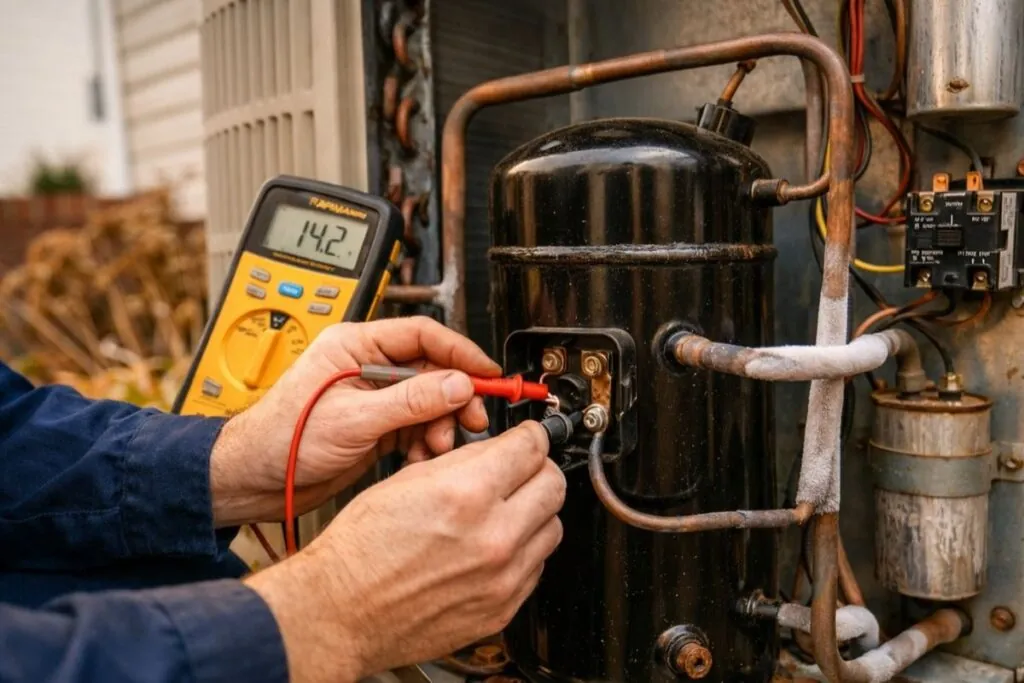
We never guess on a compressor diagnosis. Our technicians isolate the compressor leads and use a specialized digital insulation tester, also called a megohmmeter, to test the internal copper motor windings.
How We Verify This: If the meter registers an electrical short to ground, meaning the electrical insulation has melted and copper is touching the steel outer shell, the compressor is structurally dead. If a technician cannot show you the electrical proof, the diagnosis is not finished.
The Secondary Risk: The Acid Burnout Trap
If a compressor suffers an electrical burnout, it triggers an intense chemical reaction that releases a highly toxic, corrosive acid throughout your existing copper refrigerant lines.
The Domino Effect: If a technician simply unbolts your old compressor and drops a new one in without chemically flushing the copper lines and installing temporary acid-suction filters, residual acid can eat through the new motor’s insulation. The brand-new compressor can permanently burn out within weeks.
Don’t wait on a risk like this — get it verified.
The While-We-Are-In-There Checklist
When BCR Works performs a comprehensive compressor swap, we protect your investment by automatically executing these critical supporting steps:
The Big Dilemma: Repair vs. Replace?
Because a compressor replacement is a major structural investment, we use a strict operational rule of thumb to help Central Maryland homeowners make the right choice.
A compressor is a major repair, but the failed part alone does not settle the decision. Use the HVAC Repair vs. Replacement Calculator to evaluate the complete evidence before choosing either path.
When to Repair
If your air conditioner is under 10 years old and the compressor is still covered under the manufacturer’s 10-year parts warranty, repair is often practical. You may only be responsible for labor, installation supplies, and fresh refrigerant.
When to Replace
If your equipment is over 10 to 12 years old, runs on obsolete R-22 refrigerant, or is out of warranty, investing thousands into a new compressor can be like putting a brand-new engine into a car with 250,000 miles.
Logistics & Expectations
Availability
Sourced through regional wholesale networks and usually requires a specialized OEM factory order.
Labor Intensity
High. This is intensive closed-loop refrigerant surgery requiring full refrigerant recovery, nitrogen-purged torch welding, and precision vacuum testing. Expect a 4 to 6-hour on-site operation.
What Does This Repair Typically Cost?
Typical price range for this repair: $2,000–$3,000, depending on your specific system and part accessibility. The exact number is confirmed during your diagnostic visit — we test the specific failure point before quoting, rather than guessing.
Frequently Asked Questions
Can I buy just the compressor and have someone install it cheaper?
Usually, no. An AC compressor is part of a sealed refrigerant system, so the repair requires licensed refrigerant handling, proper recovery, evacuation, brazing, charging, and startup testing. Most manufacturers also require the compressor to be sourced and installed through a licensed contractor for warranty coverage to remain valid.
Will my homeowner’s insurance cover a dead AC compressor?
Most homeowner’s insurance policies do not cover an AC compressor that failed from age, normal wear, or lack of maintenance. If the failure was caused by a documented event such as lightning, storm damage, or a verified electrical surge, coverage may be possible. A clear diagnostic report helps your adjuster understand what failed and why.