
Heat Pump Auxiliary & Emergency Electric Heat Guide
Expert HVAC Solutions Across Harford, Baltimore, and Howard Counties
A clear guide for Central Maryland homeowners dealing with stuck auxiliary heat, emergency heat, or sudden winter electric bill spikes.
🛑 "Aux Heat" Light Constantly On? Let’s Stop the Utility Bill Spike
If your thermostat is constantly displaying "Aux Heat" or "Emergency Heat" even when outside temperatures are mild, your system is likely locked into its backup electric resistance heating elements. While these coils provide crucial emergency warmth when outdoor temperatures plunge below freezing, running them continuously can easily double or triple your monthly electric bill. At BCR Works, we don't just replace parts blindly—we diagnose exactly why your primary heat pump is dropping out and forcing the backup system to carry the heavy load.
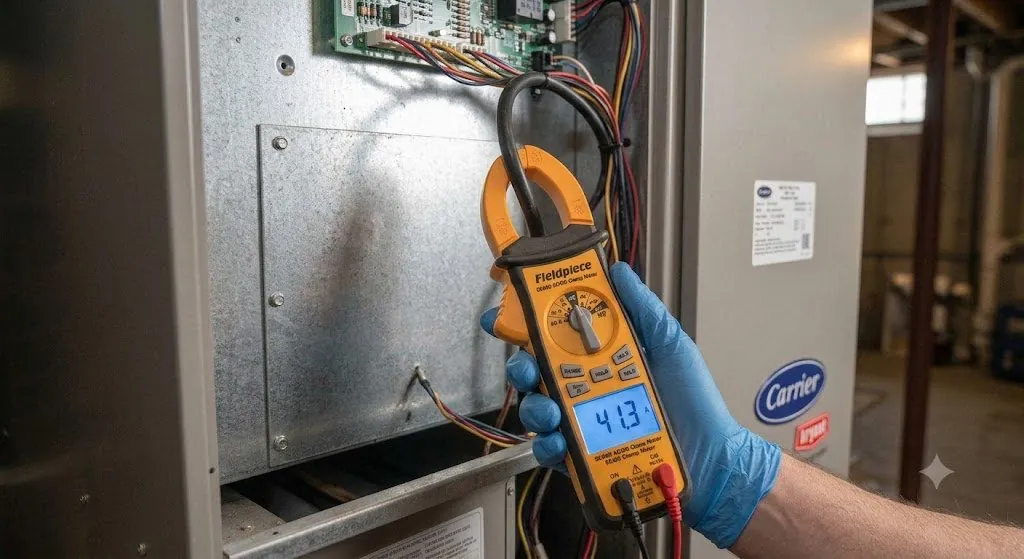
Testing electrical continuity and safety thermal limits on an indoor electric backup heat kit assembly.
💬 The Plain-English Translation: What Is Auxiliary Heat?
The Analogy: Think of your heat pump like a highly efficient hybrid car engine, and the auxiliary heat strips like a gas-guzzling reserve tank. On most winter days in Central Maryland, the outdoor heat pump handles 100% of the work cleanly and cheaply. But when a bitter cold snap drops temperatures below 30°F, or when you suddenly raise the thermostat by more than two degrees, the indoor "toaster coils" automatically switch on to provide an extra boost of instant heat.
🔍 Troubleshooting the Root Cause: Why Is It Stuck On?
When auxiliary heat runs constantly, it is usually a symptom of a completely separate underlying failure. Common issues include:
- Low Refrigerant Charge: If your outdoor unit has a slow refrigerant leak, it loses its ability to pull heat from the outdoor air, forcing the indoor electric backup system to run non-stop to meet your target temperature.
- Failed Outdoor Defrost Board: If the outdoor control board fails to clear ice off the coils, the heat pump suffocates, forcing the system into permanent auxiliary backup mode.
- Stuck Sequencer Relay: The internal electrical relays (sequencers) that control the power flow to individual heating elements can physically weld themselves shut over time, leaving the electric heat coils running even when the thermostat says the system is turned off.
- Thermostat Wiring Misconfiguration: A newly installed DIY smart thermostat that isn't programmed correctly for a heat pump system will frequently trigger the backup electric heat strips instead of the outdoor compressor cycle.
⚠️ How We Verify This: Guarding Against Oversold Heat Kits
If a technician tells you that your entire air handler or "heat kit" needs to be replaced because of a heating failure, ask to see the electrical testing values. Individual electric heat elements can burn out just like incandescent light bulbs, but you rarely need to replace the entire metal housing assembly. Many times, the issue is simply a blown thermal limit safety switch ($45 part) or a bad sequencer relay ($65 part) that has opened up to protect the system from overheating.
Don't wait on a risk like this — get it verified.
🔧 The BCR Works Precision Safety Checklist
Because backup electric heat handles massive amounts of electrical current (often pulling 50 to 100 amps across high-voltage lines), safety is our highest priority during service visits:
- Individual Element Amp-Draw Testing: We measure the precise current draw on each individual heating bank to verify exactly how many kilowatts of heat are deploying, catching broken coils instantly.
- Thermal Limit Testing: We test the high-temperature safety cutoffs to ensure that if your indoor blower fan motor ever fails, the electric heat strips will instantly snap off before causing a fire hazard.
- Thermostat Calibration Loop: We inspect and test the low-voltage communication wire loop between your wall thermostat and indoor control board to ensure the primary outdoor compressor always gets first priority before backup heat is authorized.
What Does This Repair Typically Cost?
Typical price range for this repair: $900–$1,600, depending on your specific system and part accessibility. The exact number is confirmed during your diagnostic visit — we test the specific failure point before quoting, rather than guessing.
❓ Frequently Asked Questions (Auxiliary & Emergency Heat)
Q: How is Auxiliary Heat different from manually selecting Emergency Heat?
A: Auxiliary Heat is an automatic supplement that may come on when a heat pump needs help meeting demand. Emergency Heat is a manually selected backup mode that normally disables the outdoor unit. This page focuses on normal Auxiliary Heat behavior; see What Is Emergency Heat and When Should I Use It? for the complete Emergency Heat explanation.
Q: When should I manually switch my thermostat over to Emergency Heat?
A: You should only use the Emergency Heat setting if your outdoor unit has experienced a catastrophic mechanical failure (like a seized compressor, broken fan blade, or a thick build-up of heavy ice) and you are actively waiting for a BCR Works technician to arrive. Do not use it as a standard winter setting, as it will dramatically increase your electric bill.
Q: Why does the air coming out of my vents feel lukewarm instead of hot when the Aux Heat is off?
A: Standard heat pumps supply air at around 90°F to 100°F, which is highly efficient but actually below human body temperature (98.6°F), making it feel lukewarm to the touch. When auxiliary electric heat strips kick in, they boost the air temperature coming out of the vents to well over 115°F, which feels much warmer but costs significantly more to produce.