
Stuck Heat Pump Reversing Valve: Second Opinion & Pricing Guide
Expert HVAC Solutions Across Harford, Baltimore, and Howard Counties
A clear second-opinion guide for Central Maryland homeowners who have been quoted for a reversing valve repair.
🛑 Diagnosed with a Stuck Reversing Valve? Don't Pay for Major Surgery Blindly.
If a local Maryland HVAC technician just told you that your heat pump needs a new mechanical reversing valve, you are looking at a complex, labor-intensive repair quote. Because this job requires cutting into your system’s sealed copper lines and handling specialized refrigerant, it is a premium fix. Before you authorize a multi-thousand-dollar repair or let a company convince you to scrap your entire unit, you need to know if the valve is truly failed mechanically, or if a simple electrical fix can get you running again.
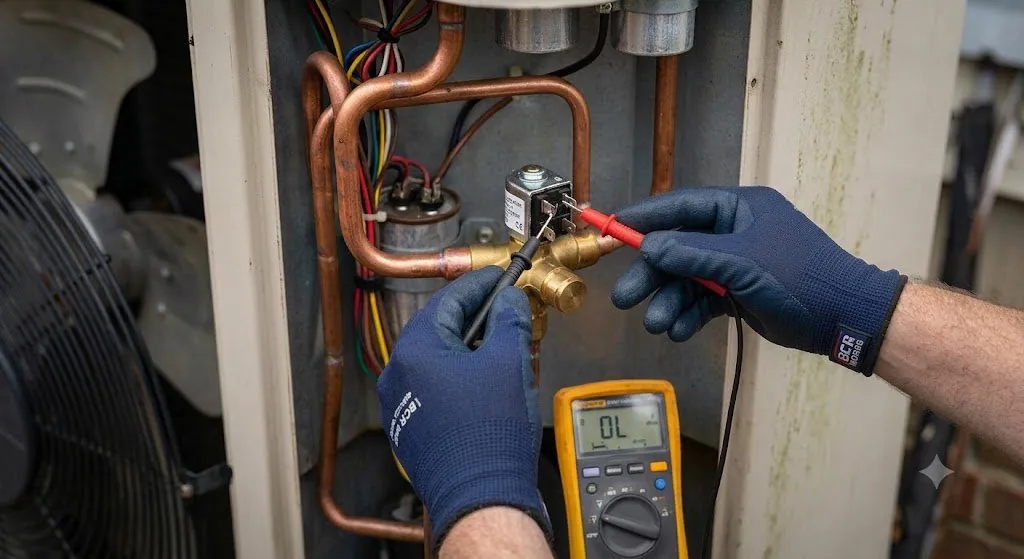
Real-world diagnostics testing voltage and mechanical alignment on a four-way reversing valve loop.
💬 The Plain-English Translation: What Does It Do?
The Analogy: Think of the mechanical reversing valve as the automated railroad switch inside your outdoor unit. A standard air conditioner can only pump heat out of your home. A heat pump is special because it can reverse its operation to heat your home in the winter. The reversing valve is a heavy, four-way copper junction that houses an internal sliding mechanism. When you switch your thermostat from cooling to heating, this internal slide physically shifts to redirect the high-pressure refrigerant gas in the opposite direction. If it gets physically stuck halfway, your system loses its seasonal identity and cannot transfer heat effectively.
🔍 Symptoms & Real-World Diagnosis
When a reversing valve experiences a mechanical failure, you will notice very specific performance issues around your property:
- The Wrong Season Blast: You turn on your heating in November, but your system defaults to blowing ice-cold air conditioning. Alternatively, you call for cooling in July and get hit with a blast of furnace-level heat.
- The Continuous Hiss: You stand next to the outdoor unit while it runs and hear a loud, constant hissing or rushing sound from inside the cabinet. This means refrigerant gas is bypassing the internal slider and recycling back into itself.
- The Lukewarm Standoff: The system runs continuously, but the air coming out of your vents is neither hot nor cold—it simply matches the room temperature.
How a Professional BCR Works Technician Verifies the Failure:
An amateur technician will often guess based on the temperature out of your vents. A BCR Works technician uses digital temperature clamps attached directly to the four copper pipes feeding into the valve. By measuring the exact temperature differentials between the inlet and outlet lines across your system in Towson, Bel Air, or Ellicott City, we can physically prove whether refrigerant gas is leaking past an internal mechanical seal.
⚠️ The Secondary Risk: The Compressor Destruction Trap
A failing or bypassing reversing valve doesn't just leave you uncomfortable—it actively threatens the life of your entire system.
Don't wait on a risk like this — get it verified.
🔧 The "While We Are In There" Checklist
Replacing a reversing valve requires surgical precision. When BCR Works handles this repair, we protect your system with these non-negotiable steps:
- Solenoid Coil Verification: We test the external electrical magnet before cutting the valve out. If the valve slider isn't moving simply because a cheap 24-volt magnet died, we replace the magnet and save you thousands.
- Wet-Rag Brazing Protection: Copper melts at high temperatures. We wrap the new valve body in specialized heat-blocking gels and wet cloths while torch-welding to ensure the internal plastic seals don't melt during installation.
- Suction Filter-Drier Addition: We install a high-capacity suction line filter-drier to trap any microscopic copper shavings or slag before they can travel downstream to damage your compressor.
⚖️ The Big Dilemma: Repair vs. Replace?
Because a reversing valve replacement requires breaking the factory-sealed refrigerant loop, we use a clear rule of thumb to guide homeowners:
- When to REPAIR: If your heat pump is under 10 years old and the parts are covered under a manufacturer warranty, replacing the valve is highly economical. You will only cover the specialty labor, welding supplies, and refrigerant recharge.
- When to REPLACE the system: If your unit is over 10 to 12 years old or runs on obsolete R-22 refrigerant, investing in a new valve is risky. The labor cost is often better spent as a down payment on a modern, high-efficiency system with a brand-new 10-year warranty.
⏱️ Logistics & Expectations
- Availability: Reversing valves are highly unique to the specific pipe layout and tonnage of your outdoor unit. This is an OEM Factory Special Order sourced through local wholesale distributor networks.
- Labor Intensity: This is an advanced, open-flame torch procedure. It requires reclaiming all refrigerant, un-brazing four separate copper junctions simultaneously, purging the lines with dry nitrogen while welding, pulling a deep vacuum to 500 microns, and weighing back in a fresh refrigerant charge. Expect a 3 to 5-hour precision operation.
What Does This Repair Typically Cost?
Typical price range for this repair: $1,000–$2,000, depending on your specific system and part accessibility. The exact number is confirmed during your diagnostic visit — we test the specific failure point before quoting, rather than guessing.
❓ Frequently Asked Questions (Reversing Valve)
Q: Can you fix a stuck valve by hitting it with a mallet?
A: While you may see this old-school trick mentioned online, it is a temporary and dangerous diagnostic practice, not a repair. Tapping a valve might occasionally jar a stuck internal slide loose for a few days, but it proves the internal slide or Teflon seals are scoring and failing. Hitting the copper body can warp the valve housing, cause an immediate refrigerant leak, or permanently lock it in place.
Q: Why do some heat pumps default to cooling when the valve fails, while others default to heating?
A: It depends entirely on your system's brand engineering. Ruud and Rheem systems are engineered to default to heating if the valve loses power or mechanical function. Almost every other major manufacturer (including Carrier, Trane, Lennox, and Goodman) defaults to cooling. This is why a broken valve wire in Maryland usually results in a freezing house during a winter storm.
Q: Can I just eliminate the reversing valve if I only want heating or cooling?
A: No. The reversing valve is an integrated structural component of a heat pump's refrigeration circuit. Eliminating it would require completely redesigning the pipe layout of the outdoor unit, violating EPA regulations, destroying the system’s efficiency ratings, and voiding all safety certifications.